Check-In vs Check-Out Inspections: What's the Difference and Why You Need Both
Two reports. Two different jobs. Here's what each one records, and why one without the other rarely wins a deposit claim.
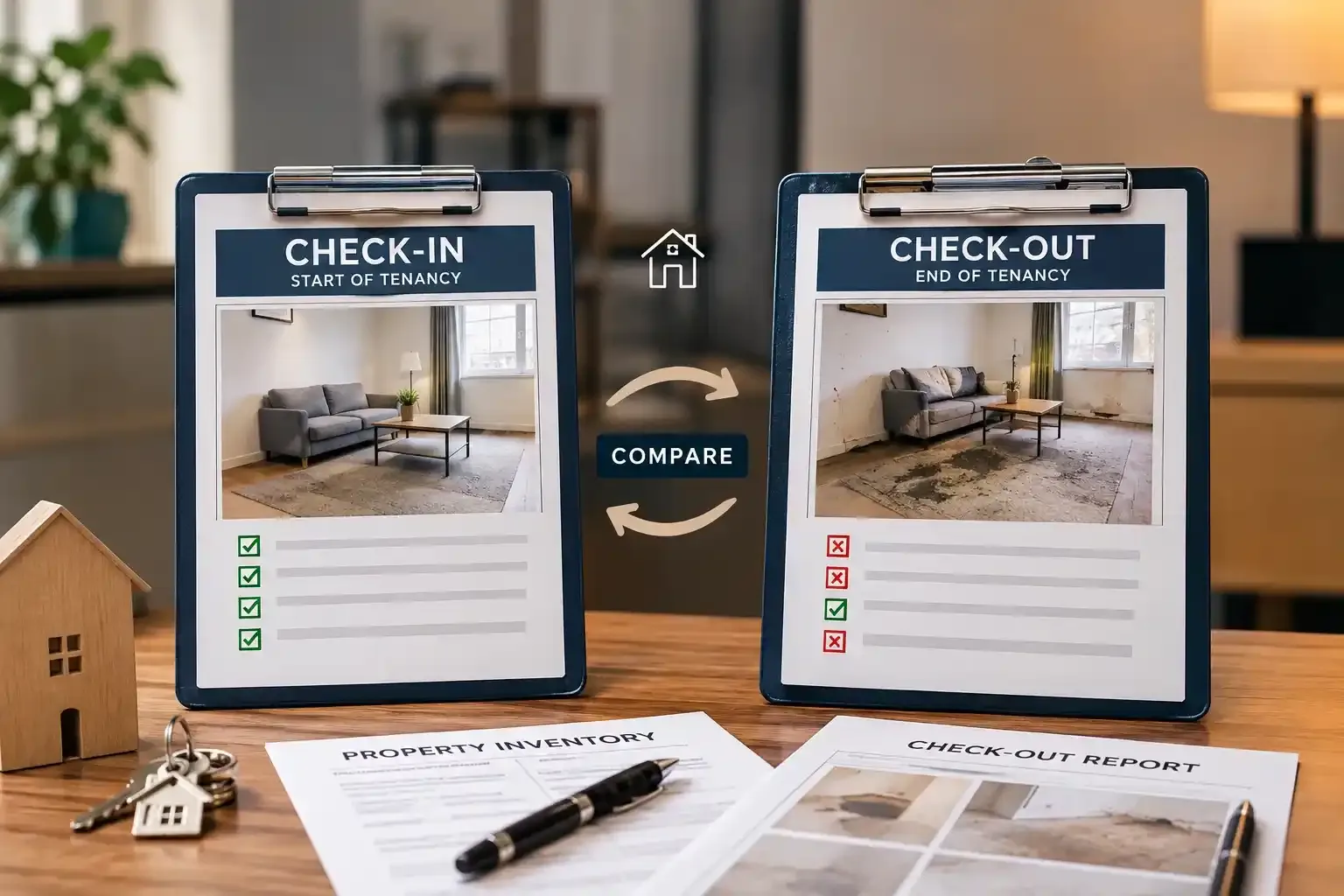
A check-in inspection records the condition of the property at the start of the tenancy. A check-out inspection compares it at the end. That's the difference between check-in and check-out inspections. One sets the baseline. The other measures against it.
On its own, neither proves much. Together they're the evidence pack that settles a deposit claim before it turns into an argument.
Most landlords I meet think these are two versions of the same job. They aren't. And the gap between them is where deposits get lost.
Is a check-in report the same as an inventory?
No. This trips up more landlords than anything else in the job.
The inventory, or schedule of condition, is the document. It's the room-by-room record of what's in the property and what state it's in.
The check-in is the appointment. A clerk attends on the day. Walks the property with the tenant. Takes the meter readings. Hands over the keys. Gets the report agreed and signed.
So the inventory is the evidence. The check-in is how that evidence gets agreed by the person you might one day be claiming against.
There's usually a gap between the two, and it matters. The inventory might be written days before the tenant arrives. Dust settles. Meters tick over. The check-in catches all of that on the day. For the detail on the document itself, I've covered what an inventory report is separately.
What's included in a check-in report?
A dated, photographed record of the property on day one, agreed with the tenant before they move a single box in.
On our check-in inspections that means:
- Room-by-room condition of walls, floors, fixtures and fittings, described properly rather than ticked as "good"
- Contents and appliances, tested where they can be tested
- High-resolution, time-stamped photographs, embedded in the report
- Gas, electricity and water meter readings, photographed
- Smoke and carbon monoxide alarms tested, with the result recorded
- Every key and fob logged, plus the garden and any outbuildings
- The tenant walked through it and signed it off Two things matter more than people expect. The photos need to be dated. And the tenant needs a fair chance to comment, usually around seven days after moving in.
That week isn't a formality. It's when a tenant can say the oven was already scratched. Deal with it then and it never becomes a dispute later.
What's included in a check-out report?
A check-out isn't a fresh survey. It's a line-by-line comparison against the check-in, done once every belonging is out.
A check-out inspection records:
- The same rooms, in the same order, using the same wording as the check-in
- Photographs from the same angles, so the pair can be read side by side
- Damage photographed with a scale reference, so a chip is measurable rather than arguable
- Condition and cleanliness recorded separately, because they are two different things
- The small stuff that gets missed. Bathroom sealant. Limescale. A damp patch behind a wardrobe
- Final meter readings, photographed
- Keys returned, and any missing
- A clear note on what's changed, and what counts as fair wear and tear One rule runs through all of it. Describe, don't accuse. "Two-inch scorch mark, centre of the lounge carpet" beats "tenant burned the carpet". The first is evidence. The second is an opinion, and an adjudicator will read it that way.
Fair wear and tear covers ageing from normal use. Faded paint. A flattened patch of carpet in a doorway. It doesn't cover a burn, a deep stain or a hole. It never applies to cleaning either. A property left dirty is left dirty, however long the tenant lived there.
One more thing on dilapidations. You can't claim a brand-new carpet for a five-year-old one. That's betterment, and adjudicators strip it out.
Check-in vs check-out inspections at a glance
| Check-in inspection | Check-out inspection | |
|---|---|---|
| When | Before the tenant moves in, once the property is ready | After the tenancy ends and everything is out |
| Purpose | Set the baseline condition | Compare against that baseline |
| Tenant present | Yes, ideally, to walk through and sign | Not essential, but they get a copy |
| Produces | An agreed schedule of condition, signed | A comparison report and a schedule of any deductions |
| Meter readings | Opening readings | Closing readings |
| What it proves | How the property started | What changed, and who's responsible |
| Without it | Nothing to compare against, so no claim | No record of the end state, so no deduction |
Why do you need both?
Because an adjudicator decides on paper. And a comparison needs two sides.
This is the part landlords underestimate. When a claim goes to adjudication with TDS, DPS or MyDeposits, nobody visits the property. Nobody rings you for your side of it. The adjudicator reads what you send, then decides on the balance of probabilities. The burden of proof sits on you.
So think about what you're sending. A check-out report says the carpet is stained. It doesn't say the carpet was clean when the tenant got the keys. Without the check-in, that's your word against theirs. And your word isn't evidence.
TDS adjudicators have said it plainly. Photographic or video inventories signed by both parties are the most effective way to support a claim. Signed by both parties. That signature only exists because someone did a check-in.
It cuts the other way too, and that's the point. A proper pair of reports protects the tenant from an unfair deduction as much as it protects you. That's why an adjudicator trusts them.
Most tenancies never get near this. In the year to March 2025, around 1% of protected deposits went to formal adjudication. But when it happens, cleaning and damage are the two biggest claim areas by a distance. Neither is provable without a check-in.
What happens if you only do one?
You lose the argument. Just in two different ways.
Check-out only. The common one. Usually the tenancy started in a rush, or the previous agent never bothered. You end up with a professional record of a tired property, and nothing showing it wasn't tired on day one. I've seen landlords produce a genuinely good check-out report and still walk away with nothing. No baseline, no claim.
Check-in only. Rarer, and just as useless at the end. You've proved how the property started and nothing about how it finished. Half a comparison settles nothing.
There's a third gap worth closing. On a long tenancy, routine property checks in the middle give you a dated timeline instead of a two-year jump between reports. That timeline is what separates slow wear from damage that happened and was hidden.
Who pays for the check-in and check-out reports?
The landlord or the agent. Not the tenant. This one isn't negotiable.
Government guidance under the Tenant Fees Act 2019 is direct about it. A landlord or agent may choose to carry out an inventory check, but cannot charge a tenant for that service. You also cannot charge a tenant for any service connected with ending a tenancy, unless the tenant asked to end it early. That covers the check-out.
You can't require a tenant to pay for a professional clean when they move out either. You can still claim reasonable cleaning costs from the deposit if the property comes back worse than it went in. But only with evidence, which brings you back to the same two reports.
If you've seen a tenancy check-out fee written into an agreement, it shouldn't be there.
When should you book them, and what do they cost?
Book the check-in for the day the property is ready, before the tenant takes the keys. Not the week after. Once furniture is in and someone has lived there a fortnight, the baseline is already contaminated.
Book the check-out as soon as the tenancy ends and the property is empty. Leave it a month and the tenant will fairly ask what happened in between. A prompt check-out also shortens the void, because you can't re-let properly until you know what needs doing.
Cost depends on the size of the property, how much is in it, and whether it's furnished. A one-bed flat and a five-bed HMO aren't the same piece of work. Tell me the property and I'll give you a straight number.
Does the Renters' Rights Act change any of this?
It raises the stakes rather than changing the duties.
Since the main provisions commenced on 1 May 2026, new tenancies in England are assured periodic tenancies with no fixed end date. So you no longer know when a tenancy will end. Move-out is decided by notice. You can't plan to sort the paperwork out nearer the time.
As Propertymark put it, in deposit disputes it isn't what's written in the tenancy agreement that decides the outcome. It's what can be evidenced.
Do the check-in properly on day one and it doesn't matter when the notice lands.
What this looks like in Birmingham
Different stock, same rules.
Around Selly Oak the calendar is the check-out. Student HMOs empty and refill in a few weeks over the summer, and every room needs its own comparison. In the city centre, turnover is faster and the arguments are about marks on white walls and worktops. Out in the east Birmingham terraces, where we're based in Stechford, it's gardens and kitchens.
The pairing never changes. The report that wins the claim is the one with a matching photo from the day the tenant moved in.
Get both ends covered
If you're letting in Birmingham or across the West Midlands, we do both ends. Signed, photo-evidenced check-ins. Dispute-ready check-outs, written to be read side by side. By an AIIC-accredited independent clerk, not an interested party.
- AIIC-accredited
- Same-day cover
FAQs
Is a check-in report a legal requirement in the UK?
No. Inventories and check-in reports aren't legally required. But without one it's very hard to prove that damage or cleaning issues happened during the tenancy, and the burden of proof sits with you.
Is a check-out report legally required?
No. There's no legal duty to give the tenant one either. It's still the document your deduction stands or falls on.
Who pays for the check-in and check-out reports?
The landlord or the letting agent. Under the Tenant Fees Act 2019 you cannot charge the tenant for an inventory check, or for anything connected with ending the tenancy.
Does the tenant have to attend the check-out?
No. They're welcome to, and it often takes the heat out of things. But the report is done on the empty property and they get a copy either way.
Are meter readings taken at both ends?
Yes. Opening readings at check-in, closing readings at check-out, both photographed. Get these wrong and you'll spend the end of the tenancy arguing about utility bills instead of the deposit.
Can a landlord do their own inventory?
You can. The problem is that you're a party to any dispute, so your photos carry less weight than an independent clerk's. If you do it yourself, date everything and get the tenant to sign it.
Can I use an independent clerk for the check-out if the agent did the check-in?
Yes, and it's common. Send us the original check-in report and we'll compare against it line by line. If you're already in a dispute, my guide to handling deposit disputes covers what to send and when.
How soon after the tenancy ends should the check-out be done?
As soon as the property is empty. Same day or next day is ideal. Every day you leave it is a day the tenant can point at.
This article is general guidance for landlords and letting agents, not legal advice. For your specific duties, check current GOV.UK guidance or speak to a qualified professional.
Written by
Founder, Capital Complete Solutions. AIIC-accredited inventory specialist, Birmingham.