Do Landlords Need a Legionella Risk Assessment?
Yes, you have a legal duty to assess and control Legionella risk in your rental. No, you don't need a certificate to prove it. Here's what that actually means in a normal Birmingham house.
Every few weeks a landlord shows me a Legionella certificate they bought online for fifteen quid. Nobody visited the property. Nobody measured the hot water. It's a PDF, and it's worth about as much as one.
Then there's the other camp. Landlords who heard the whole thing is a con, so they've done nothing at all.
Both are exposed. The duty is real. The certificate isn't. Let me explain the difference, because that gap is where people get caught out.
What is Legionella?
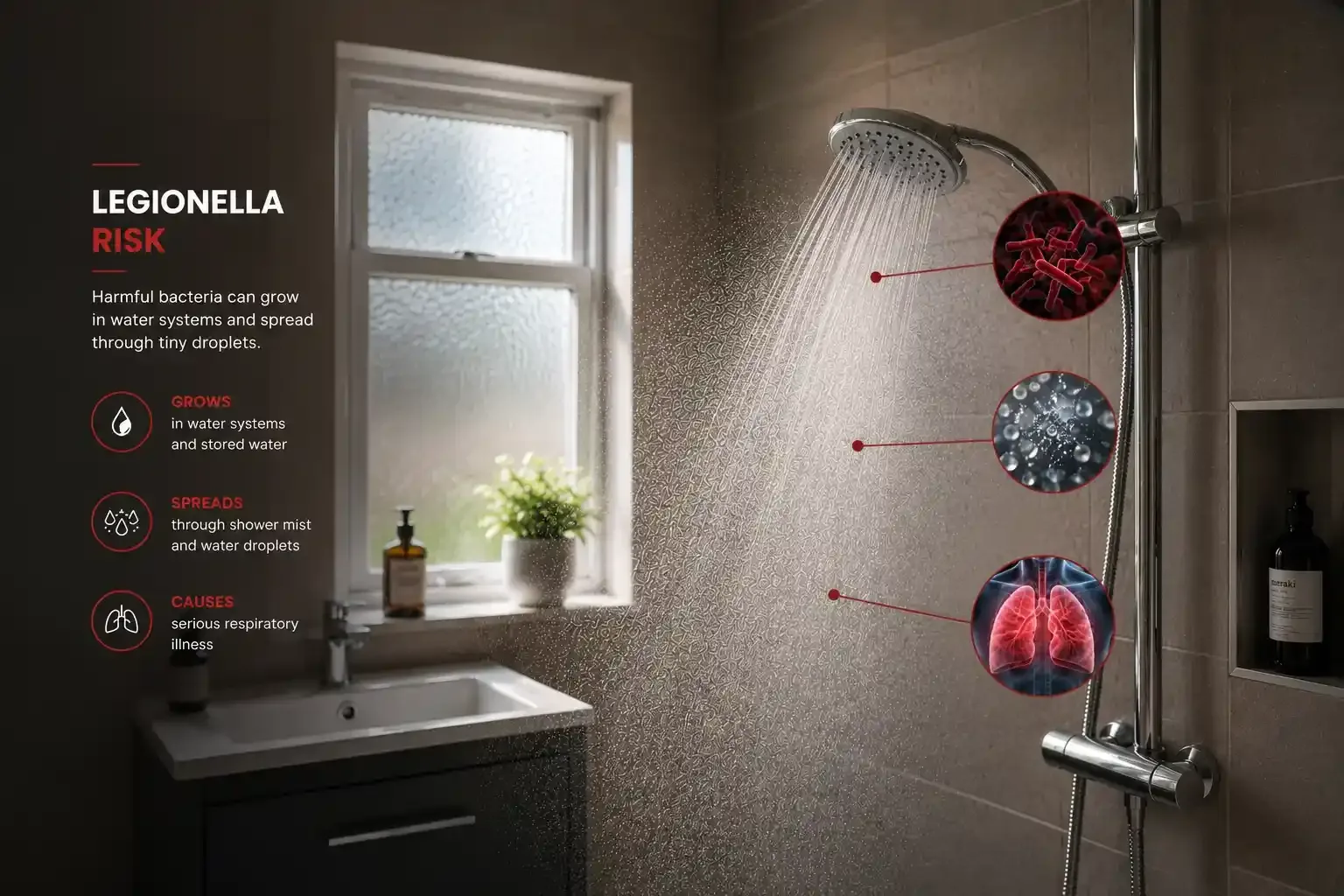
Legionella are bacteria that live in water. They multiply between roughly 20°C and 45°C. They cause Legionnaires' disease when someone breathes in fine water droplets, or aerosols, carrying them.
A shower is the classic source in a home. It turns water into exactly the sort of spray that reaches the lungs.
Now the honest bit. Most domestic water systems are low risk. Water gets used every day. It moves. It doesn't sit still long enough to become a problem. The HSE says as much: a simple assessment may show there are no real risks and they're already being properly managed, so no further action is needed.
So no, your two-bed terrace in Acocks Green with a combi boiler is not a ticking bomb. The risk climbs when water goes stagnant, sits at the wrong temperature, or when there's a tank in the loft nobody has opened in fifteen years. Working out which of those you've got is the whole job.
What are the symptoms of Legionnaires' disease?
It looks like a bad flu at first. High fever, cough, headache, aching muscles, shortness of breath. It can develop into serious pneumonia. It's treated with antibiotics.
Older people, smokers and anyone with a weakened immune system are most at risk. That matters when you're assessing a property. A retired tenant in a house with a loft tank is a different risk picture to two twenty-somethings in a new flat.
If a tenant tells you they've been diagnosed, take it seriously and act the same day.
Is a Legionella risk assessment a legal requirement for landlords?
Yes. The duty is real, even though no piece of Legionella legislation mentions residential lettings by name.
It comes from two places. Section 3(2) of the Health and Safety at Work etc. Act 1974 makes you responsible for the health and safety of people affected by your business. Letting property counts. The Control of Substances Hazardous to Health Regulations 2002, or COSHH, then require you to identify and assess the risk from biological agents. Legionella is one of them.
The HSE's Approved Code of Practice L8 and its guidance document HSG274 Part 2 set out how it's done in hot and cold water systems.
There's a housing law angle too. The Homes (Fitness for Human Habitation) Act 2018 says a rented home must be fit to live in for the whole tenancy. A water system growing bacteria is not that.
What the law asks for is a suitable and sufficient assessment. Suitable and sufficient for a standard flat looks nothing like suitable and sufficient for a hospital. You do what is reasonably practicable. Proportionate is the word that matters here, and it's the word the certificate sellers leave out.
These duties apply across the UK. The council enforcement route described further down is the England and Wales one.
Do landlords need a Legionella certificate?
No. This is the most misunderstood point in landlord compliance, so I'll quote the HSE word for word. "Health and safety law does not require landlords to obtain or produce a 'legionella test certificate'."
There is no legally mandated Legionella certificate for a rented home. It isn't like an EPC, an EICR or a gas safety record. Those are specific documents required by specific regulations. This isn't.
So why does everyone sell one? Because "certificate" sells better than "written assessment". And because plenty of landlords, and a fair few letting agents, have never checked. The NRLA says the same thing we do.
What you actually need is the assessment itself. Written down. Dated. Listing what you found and what you're doing about it.
That record is what protects you if a tenant falls ill, if the council asks, or if your insurer starts digging. A form filled in online by somebody who never set foot in the property protects nobody.
If your agent insists on a certificate, that's their policy, not the law. Ask what they'd accept instead. A properly documented assessment usually settles it.
Do you have to test the water for Legionella?
Almost certainly not. Legionella testing requirements in the UK are narrower than the market pretends. The HSE is clear that sampling is only needed in very specific circumstances. It is not usually required for domestic hot and cold water systems.
Testing and assessing are two different jobs. A lab sample tells you whether bacteria were at that outlet on that day. An assessment tells you whether your system is set up so they can't take hold at all.
The second one is what the law asks for. Temperature control does the heavy lifting.
What does a Legionella risk assessment involve?
Walking the property and understanding its water system. On a normal domestic let, that means:
- Identifying the system. Combi boiler, hot water cylinder, or a cold water storage tank feeding the house.
- Checking hot water is stored at 60°C in the cylinder, or calorifier, and coming out hot at the tap.
- Checking cold water stays below 20°C. Look for cold pipes running past a hot cylinder or through a warm loft.
- Inspecting any tank. Tight lid, no debris, no scale, and a note of when it was last looked at.
- Finding dead legs and redundant pipework. That's old pipe left in place after a bathroom got moved. Still full of water, never used. Perfect breeding ground.
- Noting showers, spray taps and outlets used rarely, like a spare en suite or an outside tap.
- Noting anything about the occupants that raises the risk.
- Writing up the findings and setting the control measures. A one-bed flat with a combi takes about twenty minutes. A three-bed with two bathrooms and a loft tank takes an hour or more.
It isn't a big job. It just needs someone to actually look. That's why we fold a Legionella risk assessment into the same visit as an inventory report rather than making a separate trip of it.
Can you do your own Legionella risk assessment?
Yes, and I'd rather tell you that than pretend otherwise. The HSE says most landlords can assess the risk themselves. You don't need to be trained or accredited.
What you do need to be is competent. In health and safety language you're the duty holder, and you appoint a responsible person to manage the risk. In a single let, that's usually you. Competent just means you understand the system in front of you and you know what you're looking at.
One modest property. Combi boiler. No stored water. Tenants living in it full time. You're happy reading a thermometer. Do it yourself. Write it down, date it, keep it. Free templates are everywhere.
Here's the catch. Do it yourself and it's on you. Miss the loft tank with no lid, or the dead leg behind the airing cupboard, and "I did my best" isn't much of a defence.
The offence under health and safety law is failing to manage the risk. Nobody has to fall ill first.
When you should get someone in
Five situations where doing it yourself stops being sensible. Between them they cover most of the properties we get called to.
Stored water. Any cold water tank, loft header tank or hot water cylinder. Older Birmingham terraces are full of them. Most landlords have never opened one.
HMOs and shared houses. More outlets. Rooms empty for weeks. Communal bathrooms. Long pipe runs. An HMO is the highest-risk domestic property there is, and if you're licensed the council can ask what you've done about water safety.
Flats with communal systems. Shared risers, or one tank serving the whole block. Work out who the dutyholder is before you assume it isn't you.
Long voids. Student lets sitting empty from June to September are the textbook case, and the HSE names them. Water standing still for three months in summer is the one genuine Legionella risk most Birmingham landlords actually have.
Portfolios. Five properties or fifty, you need the same standard on all of them, with dates you can find in thirty seconds. That's a systems problem, not a DIY one.
How often does a Legionella risk assessment need doing?
There is no fixed legal interval. The HSE's position is that you review the assessment when there's reason to believe it may no longer be valid. Industry practice, including NRLA guidance, is a review at least every two years even for low-risk property.
Here's my practical rule. This is our recommendation, not a legal requirement.
- At every change of tenancy. You're in the property anyway for the check-in inspection.
- After any work on the water system. New boiler, new bathroom, cylinder swapped, pipework altered.
- After any void longer than a few weeks. Flush everything through before the next tenant moves in.
- Every two years regardless, as a backstop. An assessment from 2019 sitting in a folder isn't a control measure. It's paperwork.
What does a Legionella risk assessment cost?
You'll see them advertised from about £15 to well over £100. That spread tells you everything.
At the bottom end you're buying a questionnaire. Nobody visits. Nobody measures your hot water. Nobody opens the loft hatch. It looks like compliance. It's evidence of nothing.
At the sensible end, someone attends. They identify your actual system, take actual temperatures, and write up what they actually found.
What moves the price: property size, number of outlets, whether there's stored water, whether it's an HMO, one property or a portfolio, and whether it's a standalone visit or done alongside an inventory or routine property visit.
Bundling it is almost always cheaper than paying for two trips.
What happens if you never do one?
Nobody is knocking on your door tomorrow. The HSE does not proactively inspect domestic rented properties for Legionella. That's exactly why so many landlords never get round to it.
The exposure shows up three other ways.
The council. Legionella risk sits inside the Housing Health and Safety Rating System under the Housing Act 2004. If your local authority finds a hazard it can serve a hazard awareness notice, an improvement notice or a prohibition order. In Birmingham that usually surfaces through HMO licensing or a tenant complaint.
Civil liability. If a tenant catches Legionnaires' disease and you have no assessment and no records, you're in a very poor position. It's a serious illness. The reported case fatality rate in England and Wales was around 3% in 2023.
Your insurer. Read your landlord policy. Failing a health and safety duty is not a comfortable conversation at claim stage.
I won't quote you a fine figure I can't verify, and I'm not here to scare you. The point is simpler than a number. This is a twenty-minute job that removes a real risk and creates a record.
What should you tell your tenants?
Four things, in writing, in the tenancy pack. Costs nothing, and it's the cheapest risk reduction you'll ever buy.
- Don't touch the hot water cylinder thermostat. It's at 60°C for a reason.
- Clean and descale the showerhead regularly.
- After a holiday, run the taps and shower for a few minutes before using them properly. Stay out of the spray while you do it.
- Report any problem with the hot water, heating or boiler straight away. If the property is empty between tenants, run every outlet weekly. That single habit deals with most void risk.
Where this fits with your other compliance
Legionella sits alongside the rest. Gas safety record every year. EICR every five. Smoke and carbon monoxide alarms. Deposit protection. The EPC rules for your rental, which are changing before 2030.
The difference is that all of those produce a certificate and this one doesn't. That's exactly why it's the duty landlords forget. Put the assessment in the same folder as the rest and it stops being the odd one out.
Getting it sorted in Birmingham
We carry out Legionella risk assessments across Birmingham, Solihull, the wider West Midlands, Warwickshire, Staffordshire and Worcestershire. Usually on the same visit as your inventory or inspection, so you're not paying for two trips.
- AIIC-accredited
- Same-day cover
FAQs
Is a Legionella risk assessment a legal requirement for landlords?
Yes. Landlords must assess and control the risk under the Health and Safety at Work etc. Act 1974 and the COSHH Regulations 2002, with the HSE's ACOP L8 setting out how. It must be suitable and sufficient, which for most homes means short and proportionate.
Do landlords need a Legionella certificate?
No. The HSE states that health and safety law does not require landlords to obtain or produce a Legionella test certificate. What you need is a written, dated risk assessment and a record of your control measures.
Can a landlord carry out their own Legionella risk assessment?
Yes. The HSE says most landlords can assess the risk themselves without being trained or accredited. You still need to be competent, and the responsibility stays with you. Bring someone in for HMOs, stored water, communal systems or larger portfolios.
How often should a Legionella risk assessment be reviewed?
There is no fixed legal interval. Review it whenever there's reason to think it's no longer valid. Industry practice is at least every two years. We recommend reviewing at every change of tenancy, after work on the water system, and after any long void.
Do you need to test the water for Legionella in a rented house?
Usually no. Sampling is only needed in very specific circumstances and isn't normally required for domestic hot and cold water systems. Temperature control is what matters.
What temperature should hot and cold water be in a rental property?
Hot water stored at 60°C. Cold water kept below 20°C. Legionella multiplies roughly between 20°C and 45°C.
How long does a Legionella risk assessment take?
About twenty minutes for a one-bed flat with a combi boiler. An hour or more for a larger house with several bathrooms, a hot water cylinder or a loft tank.
Does a flat with a combi boiler still need an assessment?
Yes, the duty still applies. A combi with no stored water is genuinely low risk, so the assessment is short and the outcome is often that no further action is needed. You still write it down.
Do HMOs need a Legionella risk assessment?
Yes, and they're the highest-risk domestic properties for it. More outlets, rooms empty for long stretches, communal bathrooms and often stored water. If you're licensed, expect your council to take an interest.
What happens if a landlord doesn't do one?
The HSE doesn't routinely inspect domestic lets. Your local authority can act under the Housing Health and Safety Rating System with a hazard awareness notice, improvement notice or prohibition order. You also carry civil liability if a tenant becomes ill, and a compliance gap can affect an insurance claim.
Is the landlord or the letting agent responsible?
It depends on your management agreement, and you rarely shed the duty completely. If your agent fully manages the property, confirm in writing who carries out and reviews the assessment. If nobody has claimed it, it's yours.
Can the Legionella assessment be done at the same time as the inventory?
Yes, and it usually should be. Combining it with an inventory, check-in or mid-term inspection means one visit, one appointment with the tenant, and a lower total cost than booking them separately.
Written by
Founder, Capital Complete Solutions. AIIC-accredited inventory specialist, Birmingham.