What Is a Property Inventory Report and Why Does It Matter?
An inventory report isn't required by law. But it's the document that decides who keeps the deposit and most landlords only find that out too late.
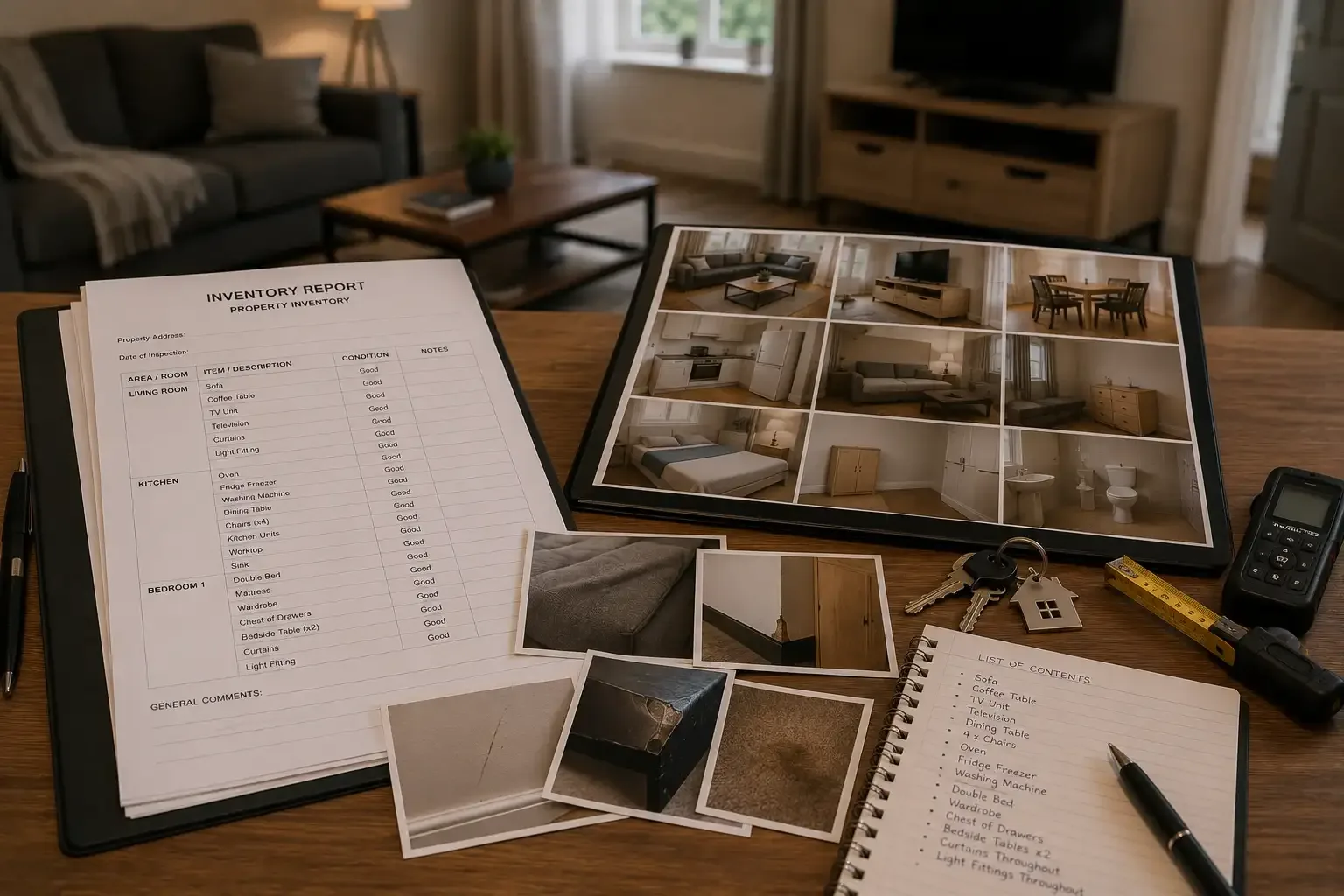
Most landlords treat the inventory as paperwork. Then a tenancy ends, a deduction gets challenged, and that paperwork becomes the whole argument. I've seen it go both ways. The difference is almost never who was right. It's who photographed the carpet on day one.
What is a property inventory report?
A property inventory report is a written and photographic record of a rented property's contents, condition and cleanliness at the start of a tenancy. It's dated. It's detailed. And it's the baseline every later comparison is measured against.
You'll hear it called a landlord inventory, a tenancy inventory, or just the inventory list. The names are half the confusion in this trade. Strictly, the inventory is the list of what's in the property. The schedule of condition is the record of what state it's all in. Put the two together and you get what most people mean by "the inventory" — and what any decent inventory report will be.
One document, two jobs. What's there, and what condition it's in.
What's included in an inventory report?
A proper inventory for a rental property covers the whole place, room by room. It records make and condition for every item. And it records cleanliness separately from condition — I'll explain why that matters shortly.
Here's the checklist I work to:
- Every room, in a fixed order. Walls, ceilings, skirting, flooring, windows, blinds and curtains, doors, light fittings and switches. Décor too — paint colour, wallpaper, any existing chips.
- Kitchen and bathrooms in detail. Units, worktops, sink and taps, sanitaryware, sealant, tiling, extractor. White goods and appliances tested, and noted as working or not.
- Fixtures and fittings, plus furnishings. Sofas, beds, mattresses, wardrobes. Make, condition, and any marks already there.
- Cleanliness, room by room. Recorded on its own, not lumped in with condition.
- Meter readings. Gas, electric and water, with serial numbers and a photograph of each dial.
- Smoke and carbon monoxide alarms. Tested on the day, result logged.
- Key log. Every key, fob and window key handed over, counted.
- Exterior. Garden, fencing, sheds, garage, loft, bin store.
- Time-stamped photographs throughout. Wide shots of each room. Close-ups of anything already damaged.
- The admin. Full address, date, report reference. The bit most reports get wrong isn't coverage. It's language. "Good condition" tells an adjudicator nothing. Propertymark sets the bar at descriptions like "light scuff marks on right-hand wall, no holes or discolouration." Be specific, or don't bother.
Who prepares the inventory?
Anyone can. The landlord, the letting agent, or an independent inventory clerk. The deposit schemes don't care who wrote it. mydeposits is explicit on this: any inventory works, as long as it's detailed enough and the tenant demonstrably received it.
What changes with an independent clerk is impartiality. When you're the one claiming money, a report you wrote yourself is evidence produced by the claimant. It still counts. It just gets weighed differently. That's why the NRLA points landlords towards clerks accredited by the Association of Independent Inventory Clerks. It's also a big part of why agents use independent clerks instead of doing it in-house.
Does the tenant have to sign it?
A signature helps. What actually matters is proving the tenant received the inventory and had a fair chance to comment on it.
This is the most expensive detail in the whole topic. And almost nobody writes about it.
The Landlord Association documented a case where a landlord commissioned a full professional inventory. He then never gave the tenants a copy or got any acknowledgement at check-in. The adjudicator rejected the claim outright and returned the entire deposit. The report was fine. The handover wasn't.
So send it by email for the time stamp. Or get a signed declaration at key handover. Tenants normally get around seven days to flag anything they disagree with. Do it at the check-in inspection and it's sorted on the day, in front of you.
Why does an inventory report matter?
Because in a deposit dispute, the burden of proof sits with you.
Propertymark puts it plainly. It's the landlord or agent who has to justify every deduction. The inventory report, they say, is "a case file, timeline and defence all rolled into one". The tenant doesn't have to prove the property was fine. You have to prove it was better.
The numbers are worth knowing. In the twelve months to March 2025, 4.7 million deposits were protected across England and Wales. Average value £1,175. Around 1% ended in a formal dispute — 46,950 cases, decided on the balance of probabilities and nothing else.
Look at what's argued over. TDS reports cleaning appearing in 54% of claims and damage in 49%. The DPS has had cleaning as its biggest cause of deductions for five years running — 29.38% of claim value in 2025.
Now here's the connection nobody makes. Fair wear and tear applies to condition. It doesn't apply to cleanliness. So the largest category of deposit claim in the country is one where the tenant has no wear-and-tear defence at all. Provided you can show how clean the place was on day one.
No cleanliness baseline, no argument.
Worth knowing the flip side too. You won't get a brand-new carpet paid for out of a five-year-old one. Adjudicators strip out betterment. What you can recover is damage beyond fair wear and tear — dilapidations, in the trade. And only in proportion to the life that item had left.
TDS's adjudicators put it well: photographic or video inventories remain the single most effective way to support a claim. They also say they routinely see landlords whose evidence doesn't show the original condition clearly enough.
What happens if there's no inventory?
You can still claim. You'll usually lose.
There's no fine for skipping the inventory. It isn't a legal requirement, and Shelter says so openly. But with nothing to compare the check-out inspection against, an adjudicator can't tell whether that chipped worktop happened last month or five years ago. No baseline, no deduction.
That's why "not legally required" and "you can't afford to skip it" are both true at once.
It got tighter on 1 May 2026, too. Under the Renters' Rights Act 2025 every tenancy is now periodic. So a check-out can land on you at any point, not at a tidy fixed-term end. Tenants also have the right to request a pet. And the pet damage insurance provision was dropped from the Act before it passed — no extra pet deposit, no compulsory insurance, same five-week cap.
The deposit is still the only cushion you've got. The inventory is what gets you into it.
Inventory, check-in and check-out — what's the difference?
Three documents, three moments:
- Inventory (schedule of condition). The record, produced before move-in.
- Check-in. The appointment where the tenant walks the property, agrees the inventory and signs.
- Check-out. The inventory check at the end, compared line by line against that same record. The chain only works if all three use the same format, wording and room order. mydeposits make exactly that point. Mix providers between check-in and check-out and you hand the tenant an argument for free.
There's more on the difference between check-in and check-out if you want the detail. A routine property visit mid-tenancy fills the gap between them.
Can I do my own inventory?
Yes. For a single unfurnished flat let to a long-term tenant, a careful job with dated photographs may well hold up.
I'd stop doing it yourself in four situations:
- You're already heading for a dispute. Once you're claiming, your own report is the claimant's evidence.
- You've got more than a couple of properties. Consistency across a portfolio is near impossible by hand.
- It's an HMO or a student let. Room-by-room schedules and shared areas need structure. Without it you can't pin damage to anyone.
- You know you won't do the handover properly. It's the step that fails most often. Be honest with yourself about number four especially.
Five mistakes that ruin an inventory report
I see the same ones every year:
- Vague wording. "Good condition" is worthless. Describe the mark.
- Undated photographs. A photo with no time stamp proves nothing about when.
- No proof of handover. Covered above. It's the big one.
- Cleanliness folded into condition. It kills your strongest claim category.
- A different format at check-out. If the two reports don't line up, neither does your case. Fix those five and you're ahead of most landlords in Birmingham.
How much does an inventory report cost?
It depends on the size of the property, furnished or unfurnished, how many rooms an HMO has, and whether you want the check-in attended too. Time works the same way. An unfurnished flat is quick. A furnished house takes considerably longer, because every item gets described rather than counted.
One thing isn't optional. You can't charge the tenant for it. Under the Tenant Fees Act 2019, inventory and check-in costs sit with the landlord or agent in England, Wales and Scotland. Weigh it against a £1,175 average deposit and the cost of losing one claim.
Get it right on day one
If you only do one thing before your next tenancy starts, make it this. Get a dated, photographic inventory produced after the clean and before the keys. Then hand it over in a way you can prove.
- AIIC-accredited
- Same-day cover
FAQs
Is a property inventory report a legal requirement in the UK?
No. No statute requires one and there's no penalty for skipping it. But deposit rules put the burden of proof on you, so without one you'll struggle to justify any deduction.
Who pays for the inventory — the landlord or the tenant?
The landlord or agent. The Tenant Fees Act 2019 bans charging the tenant for inventory or check-in costs in England, Wales and Scotland.
Does the tenant have to sign the inventory?
Not strictly. What matters is proving they received it and had a chance to comment. A time-stamped email or a signed declaration at key handover will do.
Should the inventory be done before or after the property is cleaned?
After. Cleaning and works first, then the report, then the keys. It has to record the property exactly as the tenant gets it.
Do I need a new inventory when the tenancy renews?
Yes, or at least a fresh dated record. Condition changes over a tenancy, and the old baseline no longer shows what you handed over.
Is dirty carpet fair wear and tear or damage?
Neither. It's cleanliness, and fair wear and tear doesn't apply to it. That's exactly why cleanliness needs recording separately at the start.
Do I need an inventory for an unfurnished property?
Yes. There's less to list, but the walls, flooring, kitchen and bathroom are exactly what disputes are usually about.
Do HMOs need a separate inventory for each room?
In practice, yes. Each let room needs its own schedule plus the shared areas. Otherwise you can't attribute damage to the right tenant.
This article is general guidance for landlords and letting agents, not legal advice. Deposit and tenancy rules change — for your specific duties, check current GOV.UK guidance or speak to a qualified professional.
Written by
Founder, Capital Complete Solutions. AIIC-accredited inventory specialist, Birmingham.