Fair Wear and Tear or Damage? How to Tell the Difference
It's the question I hear most at check-outs. Someone points at a mark on the wall and asks, "Is that wear and tear, or is it damage?"
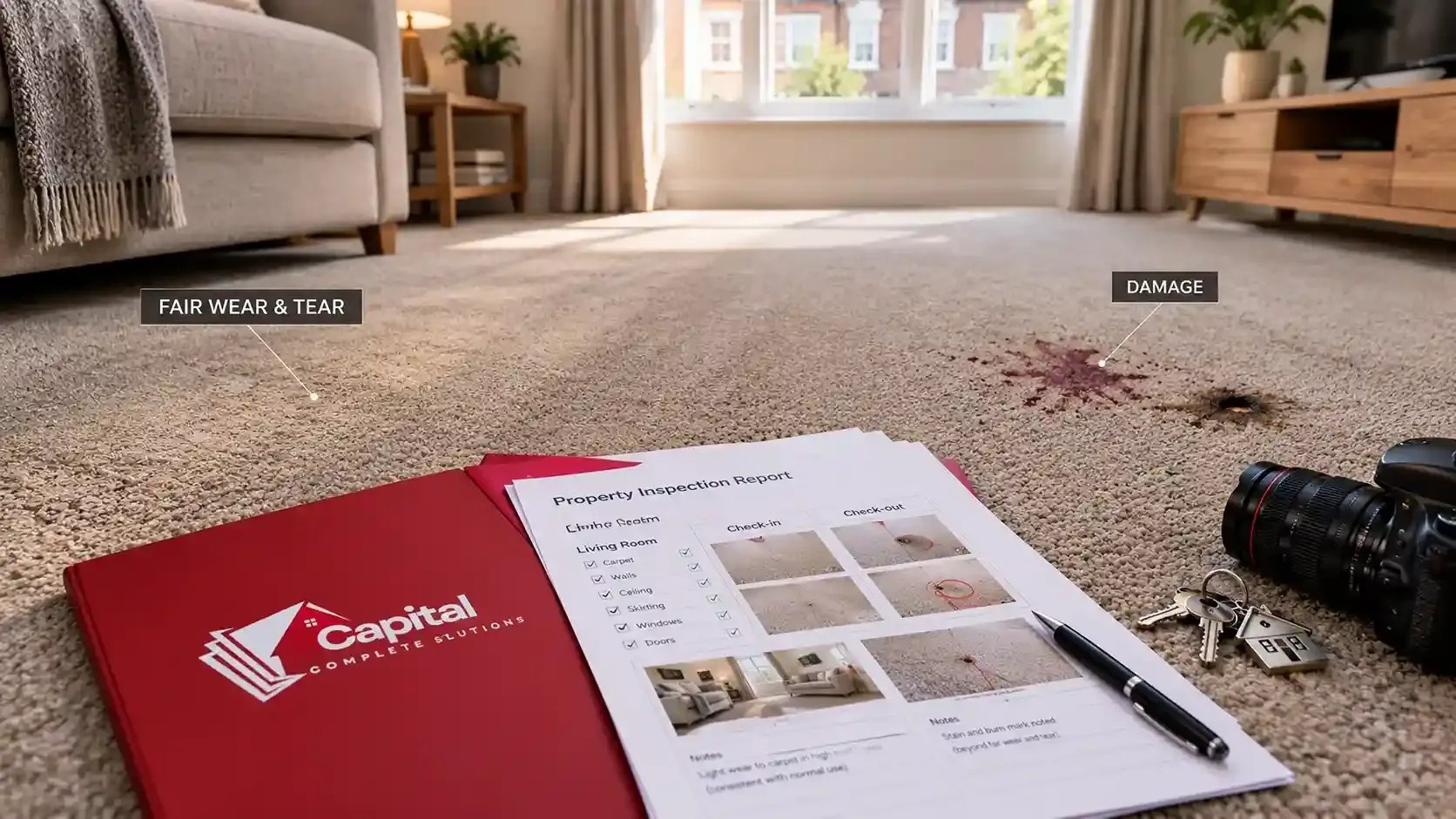
The answer decides who pays. Fair wear and tear is the normal decline that comes with everyday living. Damage goes further. It comes from an accident, carelessness or misuse. You can claim for damage from the deposit. You can't claim for fair wear and tear.
Real cases are rarely that neat. A carpet walked on for three years is worn. A carpet with a red wine stain is damaged. Plenty of marks sit somewhere in between, and that's where the report decides it.
It's also an argument landlords are having more often. Damage made up 18.42% of DPS deduction claims in 2025, up from 14.60% in 2021.
This guide shows where the line falls, and what you can fairly claim.
What is fair wear and tear?
Fair wear and tear is the decline you'd expect when someone lives in a property normally. The DPS uses a House of Lords definition. It calls it "reasonable use of the premises by the tenant and the ordinary operation of natural forces".
In plain English, two things cause it. People living there, and time passing. Carpets flatten where people walk. Paint fades where the sun hits it. Nobody has done anything wrong.
Is fair wear and tear defined in law?
Not in any Act of Parliament. There's no official list of what counts. The deposit schemes and their adjudicators apply the principle case by case.
Most tenancy agreements say the tenant must return the property in the same condition, "fair wear and tear excepted". That phrase protects the tenant. They pay for damage, but not for normal ageing.
What's the difference between fair wear and tear and damage?
The difference is the cause. Wear and tear comes from normal use over time, and it builds up slowly. Damage comes from an accident, carelessness or misuse, and it often happens in a moment.
| Fair wear and tear | Damage | |
|---|---|---|
| What causes it | Normal use and time | An accident, carelessness or misuse |
| How it happens | Gradually | Often suddenly |
| Who pays | The landlord | The tenant, from the deposit |
| Example | A worn hallway carpet | A burn or a permanent stain |
A simple test for any mark
Ask one question. Would the item look like this anyway, after the same time in normal use? If yes, it's wear and tear. If no, it's damage.
Wear and tear vs damage, room by room
| Area | Usually fair wear and tear | Usually damage |
|---|---|---|
| Carpets | Flattened pile in walkways, furniture dents, fading | Burns, permanent stains, rips, pet scratching |
| Walls and paint | Light scuffs, minor marks, faded paint, small plaster cracks | Large holes, crayon or pen, heavy marks across a room, painting without permission |
| Hard floors | Light surface wear where people walk | Deep scratches, gouges, water damage |
| Kitchen | Worn worktop surface, loose handles, tired hinges | Burns, chips and cuts in worktops, broken units or doors |
| Bathroom | Dulled sealant, ageing grout | Cracked basin or bath, broken fittings |
| Furniture | Worn fabric, sagging cushions after years of use | Rips, burns, broken frames, stains that won't clean |
| Curtains and blinds | Sun fading, gradual fraying | Tears, broken mechanisms |
| Garden | Weathered fences and decking, a thinning lawn | Neglect where the tenancy makes the tenant responsible, rubbish left behind |
Read every row as "usually". The same scuffs can be wear and tear after five years and damage after six months.
Can a landlord charge for fair wear and tear?
No. The DPS says landlords can only claim for wear and tear that goes beyond normal use. At that point, it counts as damage.
What can you claim for?
You can claim for:
- Damage beyond normal wear and tear
- Missing items that are listed on the inventory
- Cleaning, where the property is dirtier than it was at check-in
- Other breaches of the tenancy, such as unpaid rent Each claim must be reasonable. It must also match the actual loss. A deduction is compensation, not profit.
Who pays to fix wear and tear?
You do. Worn carpets, faded paint and tired kitchens are a normal cost of letting. Plan to refresh them between tenancies.
How do adjudicators decide what counts as wear and tear?
They look at five things.
- Length of tenancy. Scuffs after six months raise questions. Scuffs after five years are expected.
- Who lived there. Five sharers put more use through a home than one professional. In Birmingham, compare a student HMO in Selly Oak with a one bedroom flat in the city centre.
- Age and condition at the start. A carpet that was already worn at check-in can't be blamed on this tenant.
- Quality and expected lifespan. A budget carpet wears out faster than a quality one.
- The evidence. Without a record of the starting condition, none of the other four can be proved. The fifth is where most claims fall down. In my experience, the argument is rarely about the carpet itself. It's about whether anyone wrote down what the carpet was like on day one.
How long should a carpet last in a rental?
There's no legal answer. But TDS and the NRLA published a product lifespan guide in 2021. These are some of its typical ranges.
| Item | Typical lifespan |
|---|---|
| Carpet, low quality | 2 to 4 years |
| Carpet, medium quality | 5 to 8 years |
| Carpet, top quality | 8 to 15 years |
| Laminate or vinyl flooring | 5 to 10 years |
| Interior decoration | 3 to 5 years |
| Oven, cooker or hob | 9 to 15 years |
Treat these as a guide, not a rule. Real lifespans vary with quality and care. TDS itself says the figures may not suit every case.
Student lets wear out faster. mydeposits has said adjudicators allow about five years for carpets and decoration in a typical let. For student tenancies, it's three.
What is fair wear and tear after five years?
Quite a lot. By five years, interior decoration has usually reached the end of its expected life. The DPS says adjudicators are unlikely to award redecoration costs after a tenancy of five years or more.
What is betterment, and why won't you get new for old?
Betterment means ending up better off than you were before the tenancy. Adjudicators won't award it. If damage cuts an item's life short, you get paid for the life it had left. You don't get a brand new replacement.
Picture a carpet that's five years old and ruined at check-out. You won't get a new carpet. You'll get what the old one was still worth. That's fair on both sides.
How to work out a fair deduction
Adjudicators call this apportionment. It's a simple depreciation sum:
Replacement cost × (years of life left ÷ expected lifespan)
The DPS gives an example. A carpet costs £500 to replace. It's two years old and should last five. It had three of its five years left, so a reasonable claim is £300.
A real carpet case
mydeposits published a case after a four year tenancy with a family of four. The landlord claimed £825 to replace the carpets. The adjudicator awarded £195.
Most of the carpets were worn at the start and past their expected life. Nothing was awarded for those. The lounge carpet was two years old and had a burn. The adjudicator allowed 60% of its £325 cost, after two years of wear.
The burn was damage. Even so, the claim lost three quarters of its value, because it asked for new for old.
Is cleaning fair wear and tear?
No. Cleaning is a separate issue. mydeposits says fair wear and tear "only applies to the 'condition' and not the 'standard of cleaning'" of a property.
Dirty isn't worn. If the oven was clean at check-in and it isn't now, that's a cleaning claim. Three years of built up grease isn't wear and tear.
The standard is the check-in, not perfection. You can claim to bring the property back to how clean it was when the tenant moved in. No more than that.
Cleaning is also the top cause of DPS deduction claims. It made up 29.38% of them in 2025.
What about the grey areas?
Some marks don't fit neatly into either column. These are the ones that come up most.
Picture hooks, nails and Blu Tack
In my view, a few small picture hook holes after a long tenancy are part of normal living. Large rawlplug holes, or shelves put up without permission, look more like damage.
Blu Tack works the same way. A mark that wipes off is cleaning. Torn paint across a whole room starts to look like damage.
Sun fading
Fading from sunlight is fair wear and tear. It's the "natural forces" part of the definition. Curtains, carpets near windows and wooden floors all fade, whoever lives there.
Children, students and pets
More people mean more wear, and adjudicators allow for that. They don't excuse damage, though. A scuffed skirting board in a family home is expected. A crayon mural isn't.
Pets matter more now. Since 1 May 2026, the Renters' Rights Act 2025 has let tenants in England ask to keep a pet. Landlords can't unreasonably refuse, or charge an extra pet fee. A plan to let landlords require pet insurance was dropped.
So the deposit is still your cover. For most lets, it's capped at five weeks' rent. Scratches and chewing are damage. Pet hair and smells are a cleaning issue.
Mould and damp
With mould, the cause decides it. Condensation from drying clothes indoors with the windows shut can come down to how the home was lived in. Damp from a leak, a broken extractor fan or a structural fault is a repair for you.
Record any damp at check-in and during routine inspections in the tenancy. Then the cause can be shown later.
What do real adjudication decisions show?
Landlords who prove the starting condition, and claim a fair share, tend to get paid. Three recent TDS decisions show this.
- A new carpet with a permanent stain. Three year tenancy, £95 claimed. Awarded in full. The carpet was new at check-in, and a professional clean couldn't remove the stain.
- Heavy marks on walls. Two year tenancy, £420 claimed. A partial award. The walls were freshly painted at check-in, so the marks went beyond wear and tear. The award was cut to reflect the age of the paintwork.
- Scratched engineered oak flooring. Five year tenancy. The landlord claimed a contribution only, and got all of it. Check-in photos showed the floor in excellent condition. It's the same lesson as the carpet case. Prove the start, and claim a fair share.
What should you do if your tenant damaged the property?
Record the damage first. Then work out a fair figure and give the tenant a chance to respond.
- Don't repair it straight away. Unless it's urgent, record it first. If you must fix it, take photos and keep the invoice.
- Record it properly. Take dated photos with something in shot for scale. Add a clear written description.
- Compare it with the check-in. If the inventory shows the item in good condition, you have a claim.
- Get real quotes or invoices. Then apply betterment, based on the item's age and expected life.
- Put it to the tenant in writing. Many deductions are agreed at this stage.
- If they disagree, use the scheme. Each deposit scheme runs a free dispute service. It's voluntary, and the courts are the other route. If you spot damage during the tenancy, raise it in writing straight away. Deposit deductions are dealt with at the end, not during the tenancy. For the full dispute process, see my guide to handling a deposit dispute as a Birmingham landlord.
How can you keep wear and tear down?
You can't stop wear and tear, but you can slow it down.
- Choose tougher finishes for busy homes. In student houses and family lets, durable flooring and wipeable paint last longer.
- Set clear rules in the tenancy. Cover picture hooks, pets and redecoration in writing.
- Inspect during the tenancy. A dripping tap or a failing seal gets fixed before it becomes a big claim.
- Refresh between tenancies. A clean start makes the next check-in easy to compare against.
What evidence settles wear and tear or damage?
A matching pair of reports. You need a check-in that records the condition, and a check-out that compares against it, line by line.
- A detailed start record. A check-in walked through with the tenant, with dated photos of every room. Note when key items like carpets were fitted, if you know.
- A prompt check-out from the same angles. The change is then clear, and it can't be blamed on the empty period after the tenant leaves.
- Neutral wording. "Burn mark, two inches wide, centre of lounge carpet" is evidence. "Tenant burned the carpet" is an opinion. The adjudicator never visits the property. If your schedule of condition is vague, the argument is lost before it starts. That's why a report from an independent, AIIC-accredited inventory clerk carries weight.
Ready when you are
Want deductions that hold up?
Most wear and tear arguments come down to one thing. What did the report say on day one? We carry out detailed inventories, check-ins and independent check-out reports across Birmingham and the West Midlands. Our check-ins and check-outs record condition properly, so wear and tear vs damage isn't a guessing game.
- AIIC-accredited
- Same-day inspections
- 24–48h reports
FAQs
What is fair wear and tear in a rental property?
Fair wear and tear is the natural decline that comes from normal use and the passing of time. Faded paint, flattened carpet in walkways and light scuffs are typical examples. Landlords can't deduct for it from the deposit.
Is accidental damage fair wear and tear?
No. Accidental damage is still damage. A red wine stain or a tile cracked by a dropped pan can still be claimed. It doesn't matter that it was an accident.
Are scuff marks on walls fair wear and tear?
Light scuffs and minor marks usually are, especially after a longer tenancy. Heavy marks across a room, large holes, crayon and pen are usually damage. The check-in record and the length of the tenancy decide the borderline cases.
Is a worn carpet wear and tear or damage?
A carpet that is flattened or faded from normal use is wear and tear. Burns, rips and permanent stains are damage. Even then, the claim is reduced to reflect how much life the carpet had left.
Who pays for redecorating after a long tenancy?
Usually the landlord. Interior decoration is commonly expected to last three to five years. The DPS says adjudicators are unlikely to award redecoration costs after a tenancy of five years or more. Damage such as large holes can still be claimed.
Is pet damage fair wear and tear?
No. Scratches, chewing and torn carpet caused by a pet are damage. They can be claimed from the deposit. Pet hair and smells are a cleaning issue.
Can I claim more than the deposit for damage?
Not through the deposit scheme. It can only deal with the money it holds. If the damage costs more than the deposit, the balance has to be claimed through the small claims court.
This article is general guidance for landlords and letting agents, not legal advice. For your specific situation, check your deposit scheme's guidance or speak to a qualified professional.
Written by
Founder, Capital Complete Solutions. AIIC-accredited inventory specialist, Birmingham.