Do You Have to Test the Water for Legionella?
Most landlords who ask me this have already been quoted for a water test. Someone has sent them a price, or an agent has asked for a certificate, and they want to know if they have to pay it.
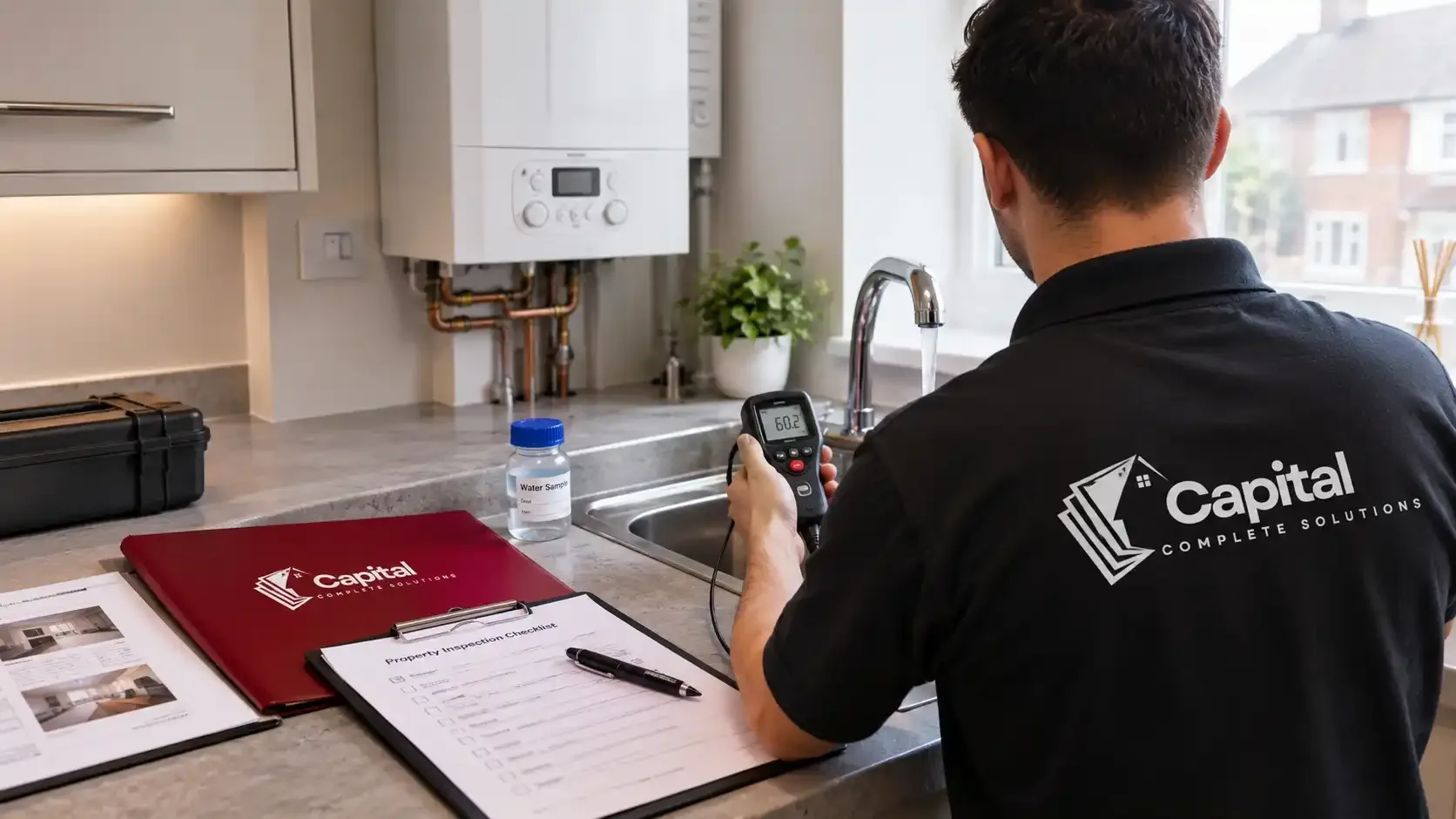
In a normal rented house or flat, you don't. The Legionella testing requirements in the UK are not what most landlords assume. The law asks you to assess and control the risk in your water system. It does not ask you to send water off to a laboratory.
The HSE says it plainly. Testing or sampling for legionella "is not usually required for domestic hot and cold water systems, and is only needed in very specific circumstances."
There is still plenty you do have to do. Here is what that is, when a test genuinely earns its place, and what to spend the money on instead.
Legionella testing and a Legionella risk assessment are not the same thing
This is where most of the confusion starts. The two get sold as one product, and they are not.
What a risk assessment does
A Legionella risk assessment looks at the whole water system in the property. Where water is stored. How hot the hot water gets. How cold the cold stays. Which outlets nobody ever uses. Whether there is a tank in the loft, and whether it has a lid on it.
It ends in a written record, dated, with a list of control measures you can act on. That is the legal duty.
What a water test does
A water test is a laboratory analysis of one sample. It is drawn from one tap, on one day, then cultured and counted. It tells you what was in that pipe that morning, and nothing more.
You can be fully compliant without ever taking a sample. You cannot be compliant without assessing the risk.
Is Legionella testing a legal requirement in the UK?
No. There is no law that makes a landlord test the water in a rented home.
What the law actually asks for
The duty comes from section 3(2) of the Health and Safety at Work etc. Act 1974 and the Control of Substances Hazardous to Health Regulations 2002. The HSE's Approved Code of Practice L8 and HSG274 Part 2 sit underneath them as guidance.
Read all four and the same two words keep coming up. Assess, and control.
There is no Legionella statute written for residential lettings. No mandatory sampling. No legal interval at which a test must happen. I covered the landlord Legionella duty in more detail separately.
Why there is no testing schedule for rented homes
You may have seen quarterly sampling mentioned in Legionella guidance. That figure is real, but it belongs to open systems such as cooling towers.
A house is not a cooling tower. Applying an industrial monitoring regime to a two-bed terrace is how landlords end up paying for work nobody asked them to do.
Which water systems carry the real risk?
The honest answer is that most domestic systems are low risk, and the ones that are not are easy to spot.
Flats with a combi boiler
A combi heats water on demand. There is no cylinder and no tank, so nothing stands still and warms up. This is the lowest risk setup you will find in a rental, and the most common in newer city centre flats.
Houses with a cold water storage tank
Stored water is the thing that changes the picture. A tank in the loft can sit warm in summer, collect debris if the lid is missing, and feed outlets nobody uses.
Plenty of older Birmingham terraces still have one. It does not make the property dangerous. It does mean the assessment has real work to do.
HMOs, bedsits and communal systems
Shared risers, long pipe runs and rooms that stand empty for weeks. This is the highest risk category in domestic property, and the one where sampling can genuinely be justified.
If you do not control the plant in a block, you still control the outlets in your own flat. Assess what you can reach, and raise the rest with the freeholder or managing agent.
When is Legionella water testing actually needed?
The HSE names the circumstances. Sampling may be necessary where there is doubt about how well the controls are working, or where the recommended temperatures are not being consistently achieved.
In a rented property, that comes down to a short list:
- The hot water will not reach temperature, or the cold tap runs warm
- There is stored water you cannot properly inspect or control
- A communal or shared system where you do not control the plant
- Vulnerable occupants in a property the assessment flagged as higher risk
- Someone linked to the property has been ill
- A previous sample came back positive
- Your risk assessment specifically recommends it Look at what is not on that list. A new tenancy. An annual tick box. An agent asking for a certificate. None of those are reasons to test.
What to do instead of testing
Control the temperatures and keep the water moving. That is most of the job, and every figure below is published by the HSE.
The temperature figures that matter
- Store hot water at 60°C. That is the temperature that kills the bacteria
- Hot water should reach at least 50°C within one minute of running the tap
- Cold water should be below 20°C after running the sentinel taps for two minutes Take the readings with a proper thermometer, not your hand.
Flushing and cleaning
- Run every outlet at least once a week. The spare shower, the outside tap, the bathroom nobody uses
- Dismantle, clean and descale showerheads quarterly, or as your risk assessment sets out
- Keep the cold water tank lid on
- Remove redundant pipework and dead legs where you can
Keeping a record
Write it down and date it. What you checked, what the readings were, what you did about anything that failed.
That record is your protection. In a dispute or a council inspection it carries more weight than a lab result from eighteen months ago.
What to tell your tenant
Give them four lines in the tenancy pack. It costs nothing and it lowers the risk:
- Do not adjust the hot water cylinder thermostat
- Clean and descale the showerhead now and then
- Run the taps and shower for a few minutes after a holiday
- Report any hot water or heating fault straight away
Can a water test replace temperature checks?
No, and this one catches people out. A test is a snapshot. Temperature control is the thing that actually keeps the risk down.
A clear sample from a system you are not controlling properly proves very little.
How often should you test the water for Legionella?
There is no testing frequency for domestic rented property, because there is no testing duty.
What does need reviewing is the risk assessment itself. Review it whenever something changes. Work on the water system. A long void. A change in occupancy. Or any reason to think it no longer holds true.
A routine property visit during the tenancy is a sensible point to check the temperatures again. It is one of the quieter arguments for regular property checks.
Do you need a Legionella certificate?
No. The HSE states that health and safety law does not require landlords to obtain or produce a "legionella test certificate."
There is no recognised certificate. Nobody official issues one and nobody official asks to see one. Buying one does not discharge your duty.
If a provider is selling you a certificate as compliance, ask them which regulation requires it. What counts as evidence is your written, dated risk assessment and your record of control measures.
Are Legionella testing kits worth buying?
They do what they claim. The question is whether what they do is what you need. Two very different products get sold to landlords under the same name.
Postal kits with laboratory analysis
You get sample bottles and instructions, take the sample yourself, then post it to a UKAS-accredited laboratory. One UK supplier lists this at £45 plus VAT, with results in around 14 days.
Rapid on-site kits
These give an indicative result in minutes rather than weeks. One supplier lists a 25 minute kit at £51.99, with a detection threshold of 100 bacteria per litre.
The two are not interchangeable. Neither replaces the risk assessment. Before buying either, try to answer one question in a sentence: what will I do differently once I have the result? If you cannot answer it, you do not need the kit.
How a proper water test is carried out
Sampling is a trade skill, not a DIY job you improvise on a Saturday.
A sample is taken to British Standard BS7592 from defined points in the system. It is then cultured by a UKAS-accredited laboratory taking part in a water microbiology proficiency scheme run by the UK Health Security Agency. The result comes back as bacteria per litre.
Who can take the sample
The HSE allows a service provider to do it. That means a water treatment company or a consultant. It also allows the operator to sample, as long as they are trained and properly supervised.
What it costs
Published UK laboratory prices start at around £45 per sample. That is for culture testing to BS EN ISO 11731. Another accredited lab publishes £82.68 per sample. A sampling visit sits on top of that.
Those are other firms' published figures, not ours. They are also the reason to check whether you need sampling at all before you pay for it.
What happens if a sample comes back positive?
You act on it, and that is the part people forget when they buy a test on impulse.
A positive result starts a job. You review the risk assessment, work out why control failed, then put it right. That usually means correcting temperatures, cleaning, disinfection, or removing dead legs. Then you resample to confirm it worked.
All of that falls on the landlord, and it costs more than the test did. Which is worth knowing before you order one out of curiosity.
What this means for Birmingham landlords
Two situations come up again and again on properties we visit across the city.
Older terraces with loft tanks
Victorian and inter-war stock across Birmingham often still has a cold water tank in the loft. Some have sat up there untouched for years.
Check the lid, take the temperatures, write it down. On most of these houses, that is the whole job.
Student houses empty over summer
A Selly Oak let can empty in June and sit untouched until September. An empty property over a warm summer is exactly where stagnant water turns into a real risk.
Flush the whole system before anyone moves back in. Run every outlet, including the ones nobody normally touches, and record that you did it. That habit does more for water safety in a student house than any sample will.
Ready when you are
Book your Legionella Inspection in Birmingham
Want a straight price rather than a range off a web page? Tell me the address, the property type, and whether there is a tank or a cylinder. I will give you a number. We carry out Legionella risk assessments across Birmingham, Solihull and the wider West Midlands.
- AIIC-accredited
- Same-day inspections
- 24–48h reports
FAQs
Do landlords have to test the water for Legionella?
In most rented properties, no. The HSE says testing or sampling is not usually required for domestic hot and cold water systems, and is only needed in very specific circumstances. Your legal duty is to assess and control the risk, not to test the water.
Is Legionella testing a legal requirement in the UK?
No. The duty comes from the Health and Safety at Work etc. Act 1974 and COSHH 2002, supported by ACOP L8. Both ask you to assess and control the risk. Neither requires water sampling in a domestic let.
Is a Legionella risk assessment the same as a Legionella water test?
No. The risk assessment is an inspection of your water system that ends in a written record and control measures. A water test is a laboratory analysis of a sample. The assessment is the legal duty. The test is optional in most rented homes.
When is Legionella water testing actually needed?
Testing may be needed where there is doubt about how well your controls are working. It may also be needed where the recommended temperatures are not being consistently achieved. Stored or communal water you cannot control, a suspected case of illness, or a specific recommendation in your risk assessment are the other triggers.
How often should water be tested for Legionella in a rental property?
There is no set testing frequency for domestic rented property, because there is no testing duty. Quarterly sampling guidance applies to open systems such as cooling towers, not to houses. Review the risk assessment when the system, occupancy or controls change.
Can a water test replace routine temperature checks?
No. A sample shows the position at one outlet on one day. Temperature control and flushing are what keep the risk down, and they are what the HSE expects you to manage.
Do landlords need a Legionella certificate?
No. The HSE states that health and safety law does not require landlords to obtain or produce a "legionella test certificate". A written, dated risk assessment and a record of your control measures are what count as evidence.
Are Legionella testing kits any good for landlords?
They work as described, but they answer a question most landlords do not need answered. Postal kits use a UKAS-accredited laboratory and take around two weeks. Rapid on-site kits give a quick indicative result. Neither replaces the risk assessment.
How do you test for Legionella in water?
A sample is taken to BS7592 from defined points in the system. It is then cultured by a UKAS-accredited laboratory. That lab should take part in a proficiency scheme run by the UK Health Security Agency. Results come back as bacteria per litre.
Who can take a Legionella water sample?
The HSE allows sampling by a service provider, such as a water treatment company or a consultant. The operator can also take the sample, as long as they are trained and properly supervised.
How much does a Legionella water test cost?
Published UK laboratory prices start at around £45 per sample for culture testing to BS EN ISO 11731. Another accredited lab publishes £82.68 per sample. A sampling visit is charged on top. Those are third party figures, quoted as market context.
What temperature should hot and cold water be in a rental property?
Hot water stored at 60°C, reaching at least 50°C within one minute at the outlet. Cold water below 20°C after running the sentinel taps for two minutes.
Do HMOs and flats with communal water systems need testing?
They are the domestic cases where sampling can genuinely be justified, because of stored water, shared risers and rooms left empty for weeks. It still depends on what the risk assessment finds, rather than being automatic.
What should I do if my rental has been empty for months?
Flush the whole system before anyone moves back in. Run every outlet, including the ones nobody uses, and record that you did it. Extended vacancy is the biggest Legionella risk most landlords will ever meet.
What happens if a Legionella test comes back positive?
You review the risk assessment, find out why control failed, and put it right. That usually means correcting temperatures, cleaning, disinfection or removing dead legs, followed by a resample to confirm.
This article is general guidance for landlords and letting agents, not legal advice. For your specific duties, check current HSE guidance or speak to a qualified professional.
Written by
Founder, Capital Complete Solutions. AIIC-accredited inventory specialist, Birmingham.