EPC Changes for Landlords: What's Changing in 2026, 2027 and 2030
Many landlords are still planning for an EPC C deadline in 2028. That date no longer exists. The main EPC changes of 2026 in the UK are now clear. Every private rental must reach band C by 1 October 2030. The EPC itself is also being rebuilt, with new-style certificates due in the second half of 2027.
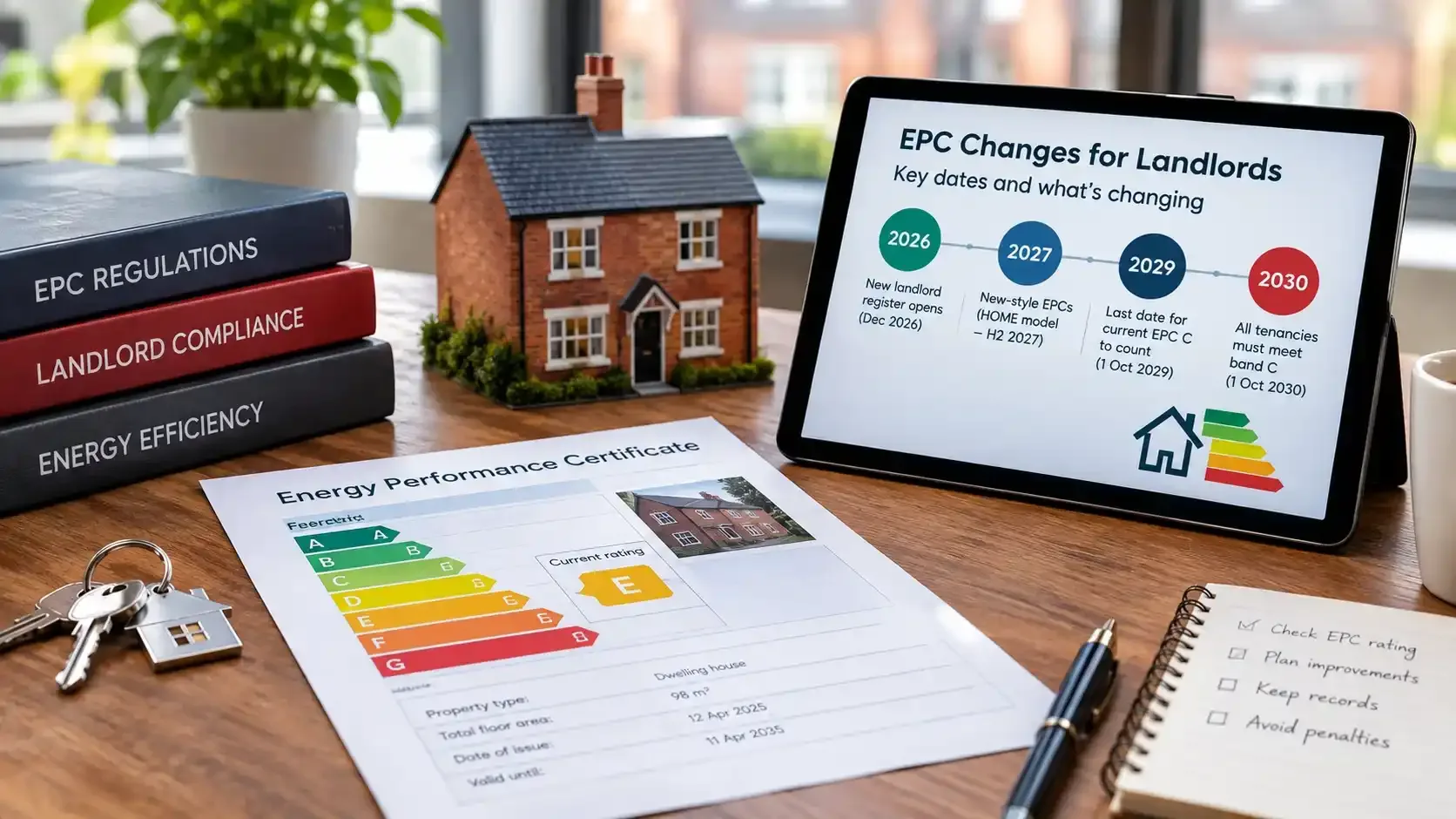
This guide sets out each date, what is confirmed and what is still a plan. It covers England and Wales. If you need the basics first, read what an EPC is and when your rental needs one.
What are the EPC changes for landlords in 2026?
Two big changes are under way. The minimum rating for rented homes is rising from E to C. The way EPCs are worked out is changing too.
The government confirmed most of the detail on 21 January 2026. It published its consultation responses on the same day as the Warm Homes Plan.
Key EPC dates from 2025 to 2030
| Date | What happens | Status |
|---|---|---|
| 1 April 2020 | Band E becomes the minimum for all private tenancies | In force |
| 1 October 2025 | Money spent on improvements from this date counts towards the new £10,000 cap | Confirmed |
| 21 January 2026 | EPC C by 2030 confirmed for all tenancies. The 2028 date is dropped | Confirmed |
| 9 March 2026 | New-style EPCs moved from October 2026 to the second half of 2027 | Confirmed |
| 15 December 2026 | New landlord register opens in the West Midlands. EPC details are required | Confirmed |
| 14 March 2027 | Registration deadline for West Midlands landlords | Confirmed |
| 2027 | New regulations planned to come into force | Planned |
| Second half of 2027 | New-style EPCs using the Home Energy Model | Expected |
| 1 October 2029 | Last date to lodge an EPC rated C on today's rating and keep it until it expires | Confirmed policy |
| 1 October 2030 | All private tenancies must meet the new standard or hold an exemption | Confirmed policy |
What is confirmed and what is still a plan
The deadline, cost cap and fines are confirmed policy. But the law itself has not been made yet, and the new EPC start date is not fixed. Check again before you spend money.
What happened to the 2028 EPC C deadline?
The 2028 deadline was dropped on 21 January 2026. There is no earlier date for new tenancies. New and existing tenancies must all meet the standard by 1 October 2030.
Why you still see 2028 online
The 2025 proposal had two dates. New tenancies would reach C by 2028, and all tenancies by 2030. Many articles still repeat it. If a page says 2028, check when it was written.
Was the EPC C rule scrapped?
It was, in September 2023. It came back through the 2025 consultation. The government then confirmed it in January 2026. So the target is back on, just later and in one step.
Scotland has its own rules. Scottish dates do not apply in England and Wales.
Can you still let a property with an EPC D?
Yes, for now. Band E is still the legal minimum, so a D rating is fine today.
The Minimum Energy Efficiency Standard, known as MEES, sets the rules. You cannot let a home rated F or G without a registered exemption. This has applied to all private tenancies since 1 April 2020. The fine today is up to £5,000 per property.
A D will not meet the new standard from October 2030. If your rental sits at D, use the next four years to plan the work.
What will the EPC C standard require from 2030?
From 1 October 2030, every private rental must meet the new standard. If it cannot, it needs a valid registered exemption. It does not matter when the tenancy started.
The £10,000 cost cap
You will not have to spend more than £10,000 per property. For lower value homes, the cap is 10% of the property's value if that is less. Today's cap is £3,500 including VAT.
Three details are worth knowing:
- Spend on qualifying work from 1 October 2025 counts towards the cap.
- Reasonable EPC assessment costs count too.
- Funding from other government schemes counts. Boiler Upgrade Scheme grants do not. Keep every invoice. The government estimates average spend at about £5,400 per property, once the cap is taken into account.
How many rental homes are affected?
A lot. The government's impact assessment says 55% of privately rented homes in England were below band C in 2023. So most landlords have at least one property to look at.
Fines of up to £30,000
Councils will be able to fine up to £30,000 per property, per breach. That is six times today's maximum.
New and longer exemptions
Exemptions will still exist. Each one must be registered on the PRS Exemptions Register to count. These are the main ones:
- Cost cap: you have spent the £10,000 and the home still falls short.
- Property value adjustment: the lower cap of 10% of the home's value applies.
- Negative impacts: a measure would harm the property.
- Solid wall insulation: you choose not to fit solid wall insulation and record that decision.
- Third-party consent: a tenant, freeholder or planning authority refuses consent.
- All relevant improvements made: nothing more can be done and the home is still below C.
- High cost: even the cheapest recommended measure costs more than the cap.
- New landlord: a six-month exemption if you have just become a landlord. The cost cap, property value and negative impacts exemptions will last 10 years. The high cost, third-party consent and all improvements made exemptions usually last five years.
When the new law arrives
The government first needs new powers through an Act of Parliament. It then aims to bring the regulations into force in 2027. Until then, some details can still change.
How is the EPC assessment changing?
The EPC is being rebuilt. The single A to G score is going, and so is the method behind it.
The Home Energy Model replaces SAP
New EPCs will use the Home Energy Model, or HEM. It replaces SAP and RdSAP, the methods assessors use today.
Four new EPC metrics
Each new-style EPC will show four headline ratings:
- Energy cost: the estimated cost of running the home.
- Fabric performance: how well the walls, roof, floors and windows keep heat in.
- Heating system: how efficient and low carbon the heating and hot water are.
- Smart readiness: how ready the home is to use smart energy technology. New EPCs will also show the old-style rating, so you can compare the two.
When new-style EPCs will start
They were due in October 2026. In March 2026 the launch moved to the second half of 2027. The government said it would agree a firm date by the summer. None had been published at the time of writing.
How long EPCs will last
EPCs will stay valid for 10 years. Existing certificates keep their full 10 years.
Will your EPC rating change?
It might. The NRLA warns that a C today is not guaranteed to stay a C under the new system. But it also reports that the fabric part is likely to stay broadly similar. So insulation work done now is not wasted.
How will landlords reach EPC C under the new metrics?
There will be two routes to compliance. Both start with the fabric of the building.
Fabric performance comes first
Every rental must meet the fabric performance standard. This is about insulation, windows and draughts.
Then heating system or smart readiness
The home must also pass one more metric. The landlord chooses either the heating system metric or the smart readiness metric.
What it means for homes with a gas boiler
In early 2026 the government consulted on how the new metrics will be worked out. Under that proposal, a home heated by a gas boiler could not score a C on the heating system metric. This is not final. If it stays, gas-heated homes would need the smart readiness route.
The proposal lists features that count towards smart readiness. These include smart meters, solar panels, batteries, smart heating controls and smart EV chargers.
Many of the older rented houses we visit in Birmingham run on a gas boiler. For those, the likely order is insulation first, then smart measures. A heat pump is the other option. It works best once the fabric keeps the heat in.
Why does an EPC C before October 2029 matter?
A C on today's rating can carry your property past 2030.
How the 2029 rule works
The rule covers EPCs lodged before 1 October 2029. If that EPC shows a C or above on the current Energy Efficiency Rating, the home counts as compliant. It stays compliant until the EPC expires or is replaced.
EPCs last 10 years. So a C lodged in September 2029 could cover the property until 2039.
Do not replace a C you already have
The protection ends when the EPC is replaced. If you hold a C, do not order a new EPC unless you need one.
Check the expiry date
A C that expires before October 2030 will not get you over the line alone. You will need a new EPC. Only one lodged before 1 October 2029 gets the same protection.
Should you upgrade now or wait?
If your rental is a D and close to C, I would do the work early. Then get a new EPC before October 2029. You get a known rating on a known method.
If it is an E with a big gap, the choice is harder. Get a current EPC assessment and read the recommendations. Price the fabric work first, because both systems reward it.
Either way, do not wait for the new EPCs to check your rating. By then you will be closer to the deadline, and competing for the same installers.
What else is changing in the EPC rules?
The reforms also change who needs an EPC. None of these changes is in force yet, and no start date has been set.
HMOs let by the room
An HMO let room by room will need one EPC for the whole building. Today, room-only lets do not need an EPC at all. This matters for student houses in Selly Oak. Our guide to HMOs in Birmingham covers the wider rules.
Listed buildings and holiday lets
Listed and heritage buildings will lose their exemption from needing an EPC. Short-term and holiday lets will need an EPC too. But they will not have to meet the band C standard for now.
An EPC before you advertise
The duty will apply from the point you market a property. So the EPC needs to be in place before the listing goes live.
EPCs that expire during a tenancy
Today you do not need a new EPC just because one expires during a tenancy. The government is still reviewing this for rented homes. No decision had been published at the time of writing.
What help is there with the cost?
Some grants can help. Each one has its own rules, so check before you plan around it.
Boiler Upgrade Scheme
Landlords can apply when they replace fossil fuel heating. The scheme gives £7,500 towards an air source or ground source heat pump. This grant does not count towards your £10,000 cap.
Warm Homes: Local Grant
Birmingham City Council runs Warm Homes: Local Grant until March 2028. Privately rented homes rated D to G can qualify if the tenant's household meets the income rules. The landlord pays part of the cost. Check the council's website for current details.
What do the EPC changes mean for Birmingham landlords?
Two things stand out here. The new register starts in our region. And much of the city's older housing will need work to reach C.
The new landlord register starts in the West Midlands
The government's Register your rental property service opens on 15 December 2026. The West Midlands goes first. Landlords here must register by 14 March 2027. The fee is £65 per property, per year.
You will need your EPC details and any MEES exemption. You will also need your gas safety record and electrical safety report. If an EPC has expired, you will find out this winter.
Older homes that need more work
Birmingham has many Victorian and inter-war terraces. Many have solid walls and gas boilers. Add converted flats and HMOs let by the room. For homes like these, the gap to C rarely closes without planned work.
What should landlords do now?
- Check every EPC on the register. Note the rating and the expiry date.
- Protect any C you already hold. Do not replace it without a reason.
- Get a fresh assessment for anything at D or below. The recommendations show what each measure is worth.
- Price the fabric work first. Think loft and wall insulation, glazing and draught-proofing.
- Keep every invoice from 1 October 2025. That spend counts towards the cap.
- Check grants before you spend. Some count towards the cap and some do not.
- Get your register details ready before 14 March 2027 if you let in the West Midlands.
Sort your EPC and your tenancy paperwork in one go
We carry out EPC assessments across Birmingham, the West Midlands, Warwickshire, Staffordshire and Worcestershire. Assessed, produced and lodged on the national register.
- AIIC-accredited
- Same-day cover
FAQs
What EPC changes are coming for landlords?
The minimum standard for private rentals rises from band E to band C on 1 October 2030. This applies to new and existing tenancies. EPCs are also being rebuilt around four new metrics, with new-style certificates expected in the second half of 2027.
Is the EPC C deadline for landlords 2028 or 2030?
It is 2030. The plan for new tenancies to reach C by 2028 was dropped on 21 January 2026. The single deadline is 1 October 2030 for all private tenancies in England and Wales.
Has the EPC C requirement been scrapped?
No. It was scrapped in September 2023, then brought back in the 2025 consultation. The government confirmed it in January 2026. The regulations are planned to come into force in 2027.
Can I still let a property with an EPC D?
Yes, for now. The current minimum is band E. A D rating will not meet the new standard from 1 October 2030 unless you register a valid exemption.
When will the new-style EPCs start?
The launch moved from October 2026 to the second half of 2027. No firmer date had been published at the time of writing.
What are the four new EPC metrics?
Energy cost, fabric performance, heating system and smart readiness. To meet the rental standard, a home must pass on fabric performance. It must also pass on either heating system or smart readiness.
Will my current EPC still be valid?
Yes. EPCs stay valid for 10 years. Certificates issued under the current system keep their full 10 years.
If my rental is EPC C now, will it count in 2030?
Yes, if the EPC was lodged before 1 October 2029 and is still in date. It counts until it expires or is replaced. Check the expiry date, because a C that runs out before 2030 will not carry you over.
How much will landlords have to spend to reach EPC C?
Up to £10,000 per property, or 10% of the home's value if that is lower. Spend from 1 October 2025 counts. If you spend the cap and still fall short, you can register an exemption that lasts 10 years.
Do grants count towards the £10,000 cost cap?
Most government funding counts towards the cap. Boiler Upgrade Scheme grants do not. Reasonable EPC assessment costs also count.
What is the fine for not meeting EPC C from 2030?
Up to £30,000 per property, per breach. The local council issues it. Today's maximum for breaking the band E rule is £5,000.
Do HMOs let by the room need an EPC under the new rules?
Yes, once the reforms take effect. One EPC will be needed for the whole building when rooms are let separately. Room-only lets do not need one today.
What EPC details do I need for the new landlord register?
You need your EPC and any MEES exemption. You also need your gas safety record and electrical safety report. In the West Midlands, registration opens on 15 December 2026 and closes on 14 March 2027.
This article is general guidance for landlords and letting agents, not legal advice. For your specific duties, check current GOV.UK guidance or speak to a qualified professional. EPC and MEES rules are changing quickly. This article reflects the position at 29 September 2026.
Written by
Founder, Capital Complete Solutions. AIIC-accredited property inventory and compliance specialists, Birmingham.