What Happens at a Check-In on Move-In Day
Everything you argue about at the end of the tenancy gets measured against what somebody wrote down that day. The chip on the worktop. The scuff on the landing carpet. The meter reading. The number of keys. If it was not recorded on the way in, it is not arguable on the way out.
Most landlords learn that eighteen months later, when a claim falls apart on one missing photograph.
So here is what actually happens at an inventory check-in, step by step, and what you need sorted before the tenant turns up.
Check-in or inventory? The difference in plain English
The inventory is the document. The check-in is the appointment.
The inventory, or schedule of condition, is the written and photographic record of the property. Condition, contents, decoration and cleanliness, room by room.
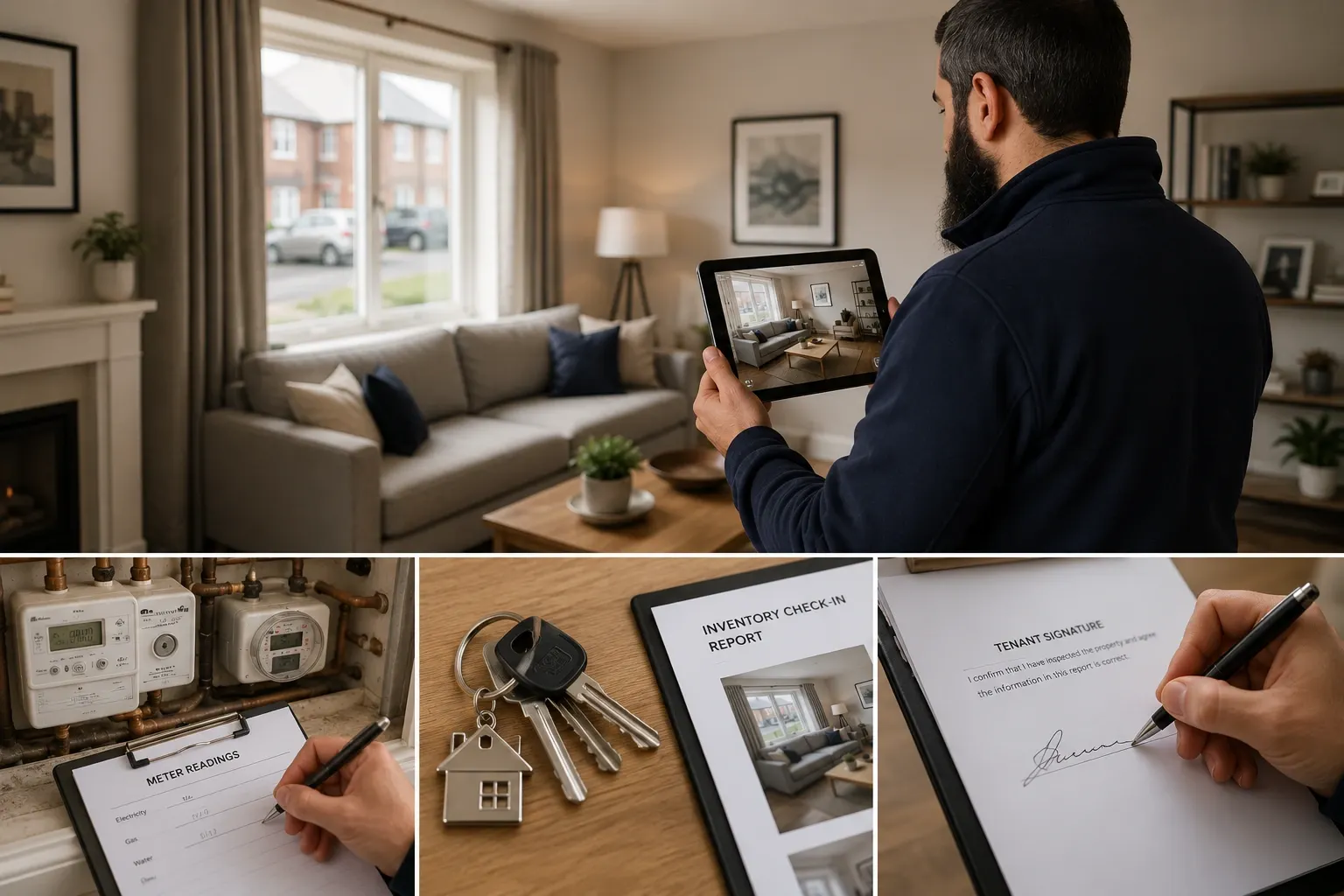
The check-in is the visit where that record gets agreed. A clerk meets the tenant and they walk it through together. Meters are read, keys are logged, the report is signed.
People use the two words as if they mean the same thing. They do not. You can have an inventory and no check-in. It is worth far less, because nobody agreed it.
There is more on how a check-in differs from a check-out elsewhere, and on what an inventory report is if you are starting from scratch.
When the check-in should happen
The check-in should happen before the tenant moves a single box in.
MyDeposits is clear on this. The inventory should be completed shortly before, or on, the day of check-in. Where possible, every tenant should get the chance to check it before any belongings go in.
Why it has to happen before the boxes arrive
Once a sofa is against a wall, that wall is gone. Boxes in the hallway hide the flooring. A wardrobe covers the one patch of damp you would have wanted on record.
In practice, the clerk goes in first and the van waits. When a check-in goes badly, it is usually because the tenant was already half moved in when we arrived.
What the property should look like first
The property needs to be finished first. Cleaned, repairs closed off, rubbish gone.
If the clerk arrives mid-refit, the report records a building site. That becomes the standard the tenant is held to at the end. Not the standard you want.
What happens at an inventory check-in, step by step
Here is the running order on a normal check-in:
- The clerk meets the tenant and explains what is about to happen.
- The walk-through, room by room, in the order of the inventory.
- The exterior: garden, garage, outbuildings, loft and bins.
- Photographs, time-stamped and embedded against each item.
- Meter readings, with serial numbers, written down and photographed.
- Smoke and carbon monoxide alarms checked and recorded as working.
- Keys, every one of them, counted and logged.
- Sign-off, with the tenant signing and dating the report. No single step is the clever bit. The value is that all of it is dated, photographed and agreed by the person who may one day dispute it.
The room-by-room walk-through
Every room is covered in the order the report is written in. Walls, ceilings, flooring, decoration, windows, doors, fixtures, fittings, white goods and furnishings.
Condition and cleanliness are recorded separately. That matters more than it sounds. Fair wear and tear applies to condition. It never applies to cleanliness.
The wording has to be specific. "Clean and tidy throughout" is not a record. A line per item, plus photographs, is.
Meter readings, and why they cause the most arguments
Take the gas, electricity and water readings. Record the serial numbers. Then photograph the meters.
That last part is the bit people skip. A typed number is a claim. A photographed meter is evidence.
Without it you get the argument where the tenant says the bill started before they arrived, or where a void period's usage lands on their account. Smart meter? Record it anyway. Smart does not mean somebody wrote it down.
Keys, fobs and window keys
Every key gets counted and listed. Two front door keys, one back door, a window key and an entry fob is a line in the report.
It sounds like a small thing. It is not. A logged key schedule is why you can charge for a lock change when a set goes missing. No schedule, no charge.
Smoke and carbon monoxide alarms on day one
In England, the alarms have to be working on the day the tenancy starts.
The rule sits in the Smoke and Carbon Monoxide Alarm (England) Regulations 2015, as amended in 2022. Each required alarm must be in proper working order on the day the tenancy begins. The test has to be done by the landlord, or on the landlord's behalf. Not the week before. The day it starts.
Here is the useful part. The GOV.UK guidance booklet suggests recording the test by having the tenant sign the inventory. The government's own suggested evidence for an alarm duty is the check-in report. No accident. It is the only document both sides sign on move-in day.
Ignore it and the local council can serve a remedial notice, then issue a financial penalty if you do not comply.
Signing the report
The tenant reads the report, raises anything they disagree with, then signs and dates it. Both sides get a copy.
Best practice is for every page to be initialled, or an online copy signed digitally. A signature on the front page alone is weaker than it looks.
What a check-in report should include
A proper check-in report contains all of the following:
- The property address and the date of the inspection
- A room-by-room schedule of condition covering decoration, flooring, fixtures, fittings and contents
- The standard of cleanliness, recorded separately for each area
- Time-stamped photographs, embedded against the items they relate to
- Meter readings with serial numbers
- A key schedule listing every key and fob handed over
- Confirmation that the smoke and carbon monoxide alarms were present and working
- Signatures and dates from both parties If a report is missing three of those, it is not a check-in report. It is a list.
Does the tenant have to attend and sign?
No law forces the tenant to attend or sign. You still want both.
A signed, dated report from a tenant who walked the property is the strongest version of this document. A report the tenant never saw is the weakest thing you can hand an adjudicator at TDS, DPS or MyDeposits.
If the tenant cannot make it
Send a copy straight away. Give them a fair, documented chance to comment, amend and return it.
Then keep the email. Proof that the report was shared, and that the tenant could respond, is what adjudicators look for.
How long they have to raise a problem
Seven to 10 days is the industry standard. Say so in writing when you send the report. If nothing comes back in that window, your starting condition is much harder to challenge later.
What else has to be sorted before the tenant arrives
The check-in is one part of move-in day. The rest is compliance, and some of it has moved recently.
The documents and certificates
For a new tenancy in England, the NRLA compliance checklist says you need:
- A written statement of key tenancy terms, given before the tenancy is agreed
- A valid Gas Safety Certificate before occupation, if there are gas appliances
- A current Electrical Installation Condition Report (EICR) before occupation
- The current EPC
- Smoke alarms on every floor used as living space, and carbon monoxide alarms in every room with a fuel burning appliance, working at the outset
- Right to rent checks on every adult occupant, before you enter into the tenancy
- The deposit protected, with the scheme leaflet and prescribed information served within 30 days of receiving it If the place has stood void between tenancies, flush the water system through on hot first. That falls under the same duty a Legionella risk assessment covers.
The How to Rent guide has gone
Update this one if you are working from an old checklist. The How to Rent guide was withdrawn on 1 May 2026.
GOV.UK now carries a withdrawal notice on it. It is kept only for tenancies where a section 21 notice was served before that date, and it is off the NRLA new tenancy checklist. Plenty of landlord blogs still tell you to hand it over. Check the current GOV.UK position first.
Pets change the maths
Since 1 May 2026, tenants have a contractual right to request a pet. You normally have 28 days to answer in writing, and you cannot refuse just because you would rather not have a dog in the property.
Deposits are still capped, so there is no pet deposit to fall back on. That leaves the day-one record doing the work. Carpets, flooring, skirting, doors, garden condition. Photograph them properly, or you will be arguing about a scratched door with nothing to compare it to.
This article is general guidance for landlords and letting agents, not legal advice. For your specific duties, check current HSE and GOV.UK guidance or speak to a qualified professional.
Is a check-in report a legal requirement, and who pays?
A check-in report is not a legal requirement. The landlord or the agent pays for it.
No law obliges you to hold an inventory or run a check-in. But with no baseline there is nothing to measure against, and the burden of proof sits with you. Claims with no agreed starting condition usually fail.
On cost, GOV.UK guidance under the Tenant Fees Act 2019 is explicit. A landlord or agent may carry out an inventory check, but cannot charge a tenant for it. An agent passing that cost to your tenants is making a prohibited payment.
Should you do the check-in yourself?
You can. Think about what you are producing first.
You photograph your own property. You write your own report. Then you claim against the deposit a year later. At that point you are both the author of the evidence and a party to the dispute.
An adjudicator weighs that differently. That independence is the product, and it is why a photographic schedule of condition from an AIIC-accredited third party holds up where a folder of phone pictures does not.
What this looks like across Birmingham
The rules are the same everywhere. The pressure is not.
Student houses around Selly Oak turn over in a few short weeks each summer. Often room by room, with a separate agreement on each one. City centre flats hand over in blocks, where one clerk walks twenty near-identical units. There, consistency between reports is the whole job.
Older terraced stock in the east of the city brings a different list. Original features, past repairs and damp histories, all worth recording on day one.
Before your next tenant moves in
If you only do one thing, do this. Get the check-in done before the belongings arrive, and get it signed.
Everything else on this page can be fixed later. That cannot. Once the boxes are in, the morning is gone. The record you are left with is the one you will lean on at the check-out, when the deposit is on the line.
Get it right on day one
Letting in Birmingham or the West Midlands? We run attended check-in inspections properly. Room-by-room schedule of condition, time-stamped photographs, meter readings with serial numbers, keys logged, report signed on the day.
- AIIC-accredited
- Same-day cover
FAQs
Is a check-in report a legal requirement in the UK?
No. There is no law requiring an inventory or a check-in report. But without one you have no agreed record of how the property started, and the burden of proving a deposit deduction sits with the landlord.
Who pays for the check-in report?
The landlord or the letting agent. GOV.UK guidance under the Tenant Fees Act 2019 says a landlord or agent may carry out an inventory check but cannot charge a tenant for this service.
Should the check-in happen before or after the tenant moves their things in?
Before. Every tenant should have the chance to check the inventory before any belongings are moved in. Once furniture and boxes are in place, parts of the property are hidden and the record is weaker.
Does the tenant have to attend the check-in?
No, but it is much better if they do. An attended check-in gives you a report the tenant has walked through and agreed on the day, which is the strongest version of this evidence.
Does the tenant have to attend the check-in?
No, but it is much better if they do. An attended check-in gives you a report the tenant has walked through and agreed on the day, which is the strongest version of this evidence.
How long does the tenant have to raise a problem with the report?
Seven to 10 days is the industry standard. Send the report, state the window in writing, and keep a copy of the email.
Do I have to test the smoke and carbon monoxide alarms on the day the tenancy starts?
In England, yes. The required alarms must be in proper working order on the day a new tenancy begins, tested by or on behalf of the landlord. GOV.UK guidance suggests recording this by having the tenant sign the inventory to confirm the alarms were tested.
What meter readings do I need at the start of a tenancy?
Gas, electricity and water where they apply. Record the serial numbers as well as the readings, and photograph the meters so the reading is dated and evidenced rather than just typed.
Do I still have to give the tenant the How to Rent guide?
The How to Rent guide was withdrawn on 1 May 2026 and is no longer on the NRLA checklist for new tenancies in England. It is retained only for tenancies where a section 21 notice was served before that date. Check the current GOV.UK position for your situation.
Does the check-in matter more now that tenants can request pets?
It does. Tenants have had a contractual right to request a pet since 1 May 2026, and deposits remain capped, so there is no separate pet deposit. A detailed day-one record of flooring, doors, skirting and the garden is what a later claim rests on.
Written by
Founder, Capital Complete Solutions. AIIC-accredited inventory specialist, Birmingham.